
Equipment buying guides
Mini Excavator Sizes — What Size Do You Need?
Affordable Tractors & Equipment
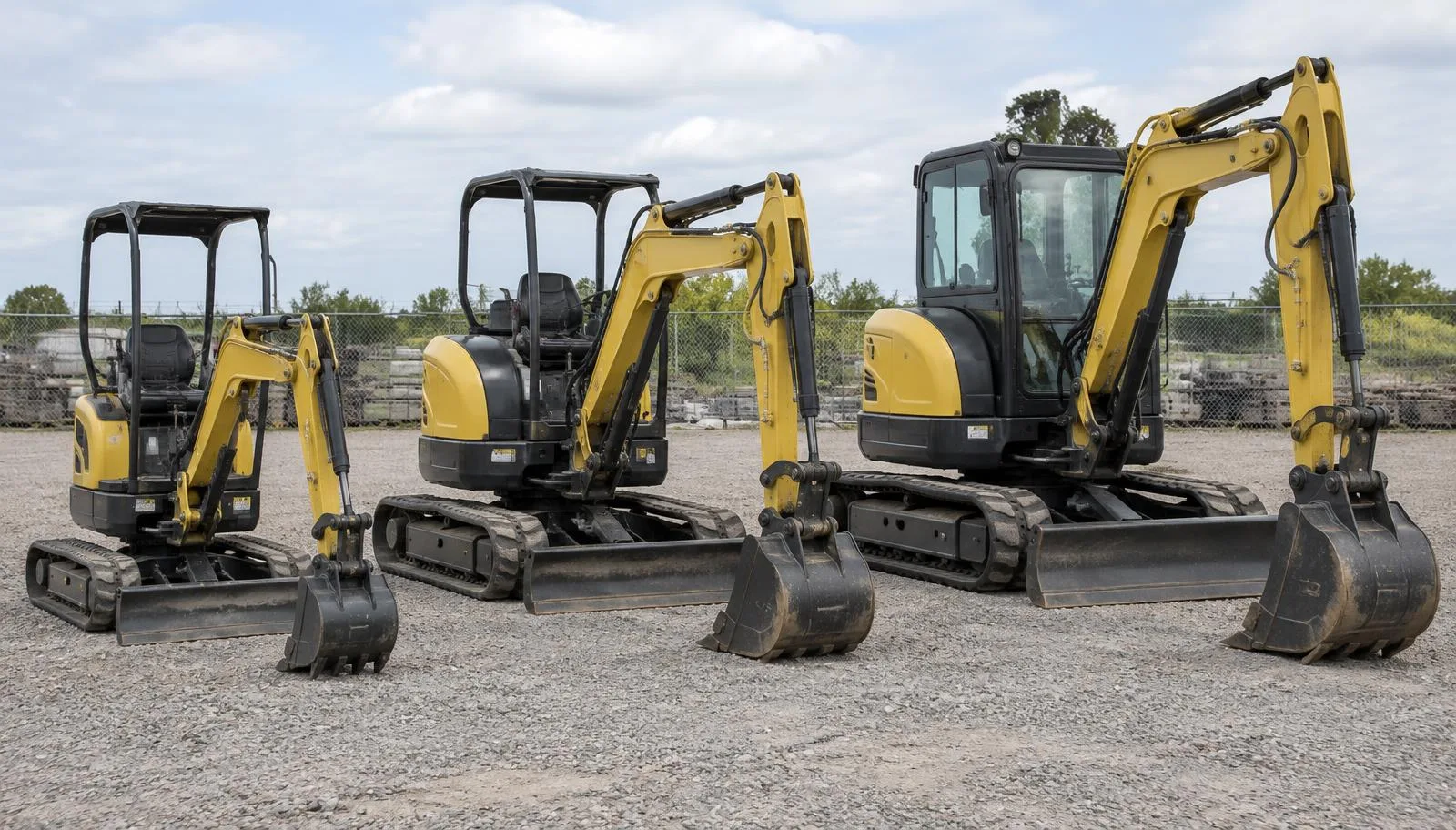
Choose a mini excavator by measuring the job and the site first. Start with the narrowest point on the access route, the depth and reach you need from the machine’s actual working position, and the weight you can transport. Then compare machines that meet those limits.
A narrow machine can be the right choice for a backyard drain. A machine with more reach and a larger bucket can save time on a long trench with open access. The right size depends on the work you’ll do repeatedly, where the excavator can stand, and where the excavated material will go.
Mini excavator size classes at a glance
Size classes are shopping ranges. A “3-ton” model can weigh more than 3,000 kg in its published configuration. A cab, track choice, blade, counterweight, or attachment can change the weight and dimensions you need to plan around. Use the following bands to start a search and confirm each candidate against its own spec sheet.
| Approximate operating weight | Where to start looking | What to verify first |
|---|---|---|
| Under 2 metric tonnes | Restricted-access landscaping, shallow drains, and small planting jobs | Narrowest travel width, blade configuration, bucket capacity, and reach from the permitted working position |
| 2 to under 3.5 metric tonnes | Residential drainage, short utility runs, and small property projects | Depth at the required reach, space to swing, spoil placement, and loaded trailer weight |
| 3.5 to under 5 metric tonnes | Recurring trenching, landscaping contracts, and jobs that need more reach or bucket capacity | Clearance around structures, dump height, working range, and access for transport |
| 5 to about 6 metric tonnes | Longer trenches and more demanding earthwork where access is open | Delivery and hauling plan, attachment compatibility, ground support, and room to place spoil |
These are starting points for common jobs. The ground, bucket, machine configuration, and room to work determine what a particular excavator can do on your site.
Compare real models before relying on the size label
The examples below show how operating weight and published dig depth vary across a single manufacturer’s range. These are specification examples, so use the exact model and configuration when you evaluate a listing.
| Example model | Published operating weight | Published dig depth |
|---|---|---|
| Cat 302 CR | 2,262 kg (4,987 lb) | 2.57 m (101.2 in) |
| Cat 303 CR | 3,545 kg (7,817 lb) | 2.95 m (116.1 in) |
| Cat 305 CR, Tier 4 / Stage V listing | 5,754 kg (12,688 lb) | 3.67 m (144.5 in) |
Source for published example figures — Caterpillar mini excavator lineup.
Verify which cab, stick, blade, bucket, and track configuration applies to the specifications you use. Manufacturers often publish different operating weights for canopy and cab versions of the same model, and some published operating weights include an operator allowance. That difference matters when you compare machines or calculate a trailer load.
Measure the whole route into the job
Measure from the unloading point to the working area. Check the narrowest gate or passage, the lowest overhead clearance, and any tight turns. A gate can look wide enough from the street while a hinge, latch, masonry post, or bend just beyond it takes away usable space. Measure between the actual obstructions.
Example. A gate has a clear opening of 1.05 m (about 41 in). A candidate has a published retracted travel width of 0.99 m (about 39 in). The difference is only 60 mm (about 2.4 in) in total. Before choosing it, verify the blade and track configuration on the actual machine, the approach angle, and whether the ground is level enough for the planned entry. Once inside, confirm there is room to set the machine up as the operator’s manual requires and to swing and dump safely.
A retractable undercarriage can help with access on models that offer one. A compact or zero-tail-swing design can help where the rear of the house would otherwise swing close to a fence or building. Check the published tail swing radius and the working clearance needed for the front of the machine. The boom, bucket, and load still need space through the full movement.
If access is the limiting factor, ask the seller for a tape-measure photo across the machine’s widest point in the configuration you would use to enter. Ask for overall height and length too if there is a low roof, covered passage, or turn immediately after the entrance.
Read the digging envelope, including reach and dump height
Published maximum digging depth tells you how far down the machine can dig under specified conditions. To size a real job, look at the manufacturer’s working-range diagram. Find the depth available at the horizontal distance where the bucket actually needs to work. Look up vertical-wall digging depth if the task calls for a vertical cut within the approved excavation plan.
Example. A contractor needs a trench 2.2 m deep (about 7.2 ft). One excavator has a published maximum depth of 2.57 m (about 8.4 ft). The difference on paper is 0.37 m (about 1.2 ft). If the machine has to stand farther away because of the site layout or the excavation plan, check whether it still reaches 2.2 m at that position. Confirm the required stand-off and ground support with the responsible site professional.
Also decide where the bucket will empty. A low spoil pile, a skip, and a high-sided truck call for different combinations of dump height and horizontal reach. Measure the side height of the receiving container and where it can park. Check that the bucket can clear the side and reach the intended discharge point. Ask for a demonstration or the relevant working-range diagram if truck loading is a recurring part of the job.
Before breaking ground, follow the local process for locating and marking buried services. Use qualified guidance for excavation stability, edge setbacks, and any protective measures required at the site. Machine selection and an excavation safety plan are separate decisions.
Choose the bucket and plan how spoil leaves the site
The bucket that comes with a used excavator may suit the seller’s work better than yours. A narrow trenching bucket can help you dig the intended width and reduce the amount of spoil you must handle. A wider grading bucket can make sense for shaping and cleanup if the machine and attachment are approved for the job. Confirm the coupler or pin dimensions, attachment weight, and hydraulic requirements where applicable.
For a rectangular trench, multiply length by width by depth to estimate the volume in the ground. A trench 20 m long, 0.4 m wide, and 1.2 m deep gives a geometric estimate of 9.6 m³. Actual excavation may differ because of the required trench shape, overdig, and site conditions. Loose material can occupy more space after excavation. Plan where it will go and how many movements it will take to get it there.
On a confined site, a bigger digging machine can still spend time waiting for spoil to be moved. If the excavator will dig while another machine shuttles material or loads trucks, compare the loader options for the surface and access you have. See our skid steer vs. compact track loader comparison.
For work with a breaker, auger, thumb, or tilt attachment, check the exact excavator’s approved equipment and hydraulic circuit. Confirm flow, pressure, control functions, and connection details as applicable. Include coupler and attachment weight when evaluating transport or asking the dealer about lifting.
Work out the actual transport load
Start with the configured machine’s weight and check what it includes. Operating weight can include an operator allowance and a specified bucket or fuel condition. For hauling, use the actual loaded equipment weight. Add separately carried buckets, couplers, and other equipment only where they are excluded from the starting figure.
Example. An excavator weighs 3,400 kg in its travel configuration. A spare bucket and other separately carried equipment add 200 kg, making 3,600 kg of cargo. On a trailer that weighs 1,100 kg empty, the loaded trailer weighs 4,700 kg (about 10,360 lb) before anything else is loaded. Compare cargo weight with trailer payload and loaded trailer weight with the trailer and towing limits that apply. Check axle loads, hitch limits, the tow vehicle’s combined rating, and local licensing and transport requirements. Verify the actual loaded setup on a scale when the margin is close.
For international delivery, request shipping dimensions and weight for the actual machine and attachments. Ask which components will travel separately, how the equipment will be unloaded at the destination, and whether the carrier can reach the site. Get the delivery arrangement clear before treating two quotes as comparable.
How to choose for three common jobs
A backyard drain through a narrow side passage. Start with the smallest classes and measure the whole approach. Shortlist machines that fit and can reach the required depth from a safe position. Decide whether the bucket can unload into the planned spoil area without striking a fence or wall. If the job is a one-off, compare the cost of a rental and delivery against buying a machine you might rarely use.
Recurring residential trenching and landscape work. Start by comparing machines in the middle weight bands. Bring three recent jobs to the comparison. For each one, list trench dimensions, access width, how spoil left the site, and where the machine had to stand. Buy around the jobs that recur. For an occasional deeper or narrower project, include the cost of renting a different machine in your comparison.
Long trenches or regular truck loading with open access. Compare larger candidates if they can work within the delivery, ground, and maneuvering constraints. Check the digging envelope and bucket specification, plus dump height and reach to the truck. Estimate how the larger machine changes working time and transport cost. Confirm that the gain matters on the jobs you do often enough to pay for it.
What to verify before buying a used mini excavator
Ask for the full model designation, serial number, hour-meter photo, equipment list, and service records. Request dimensions and weights for the actual machine. A replacement bucket, aftermarket coupler, different tracks, or counterweight can affect the comparison you made from the factory brochure.
Ask for a cold-start and operating demonstration by a qualified operator. Have the undercarriage, boom and arm pins, swing system, blade, coupler, and hydraulic hoses inspected. If the machine has variable-width tracks or auxiliary hydraulics you intend to use, ask to see those functions demonstrated. Verify any specific attachment you need is included or compatible before you commit.
For a remote purchase, request a continuous walkaround that shows the serial plate, attachments, both sides of the undercarriage, and the machine in operation. Ask for close-ups or measurements of the features that determine whether it will fit your site. Consider an independent inspection, and follow our guide to verifying the seller and payment instructions when buying equipment online.
Frequently asked questions
What size mini excavator do I need for a drainage trench?
Start with the trench depth and width, the machine’s permitted working position, and the access route. For restricted residential access, look at smaller models first. Compare their working-range diagrams at the reach you need and check how you will remove spoil.
How much does a 3-ton mini excavator weigh?
The class label gives a rough idea. The actual operating weight depends on the model and configuration. For example, Caterpillar lists the 303 CR at 3,545 kg (7,817 lb). Confirm the actual machine’s operating and transport weights separately when choosing a trailer or getting a shipping quote.
Can a mini excavator fit through a standard gate?
Measure your gate’s clear opening and the turns before and after it. Compare those measurements with the actual machine’s travel width, including blade and tracks. Leave room for the approach, surface conditions, and safe maneuvering.
Can I size a mini excavator for lifting by its operating weight?
Use the manufacturer’s lift chart for the exact machine and configuration. Ask a qualified operator or dealer to verify the load, attachment, lift radius, height, orientation, and setup. Include lifting equipment and attachments as the chart and manual require.
What should I tell a seller when asking for a quote?
Send the access width and height, required digging depth and horizontal reach, bucket or attachment needs, and delivery destination. If you plan to haul it yourself, give the seller your trailer payload and the relevant towing limits. When you browse available equipment, use those measurements to narrow the list and ask for the spec sheet for the exact model offered.