
Equipment buying guides
Skid Steer vs. Compact Track Loader — Which Should You Buy?
Affordable Tractors & Equipment
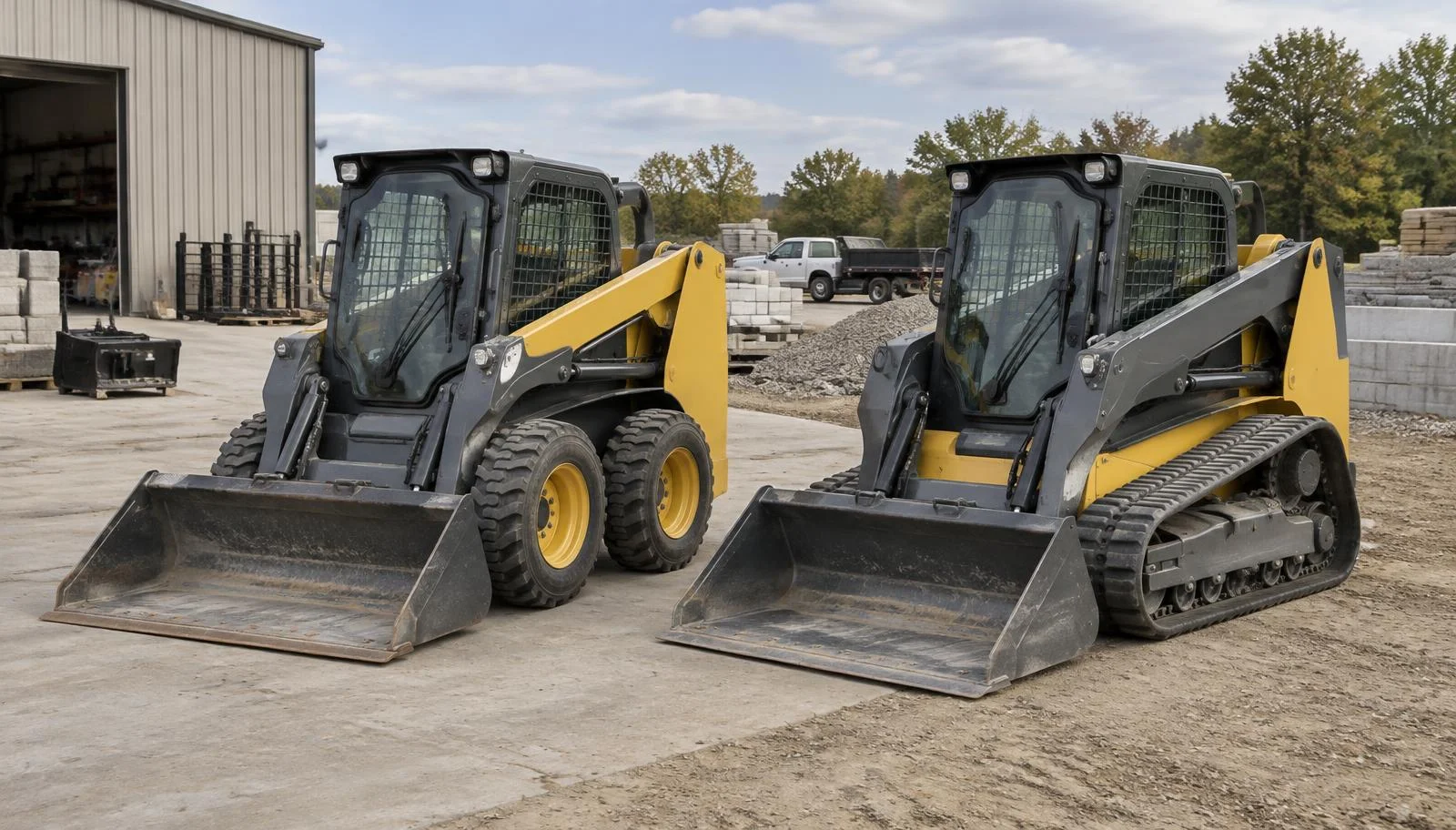
A wheeled skid steer is usually the better starting point for work on concrete, asphalt, and firm yards. A compact track loader is usually the better starting point for recurring work on soft soil, loose fill, or ground that becomes difficult to cross after rain. Then compare individual models for lift capacity, attachment compatibility, transport weight, and the cost of keeping the machine working.
The easiest way to get this decision wrong is to shop by horsepower, price, or the most impressive lift number before looking at where the loader will spend its time. A machine that looks inexpensive in the listing can cost you money every time the ground turns soft. A tracked machine that handles those conditions well may spend most of its life wearing its undercarriage on a concrete yard.
What’s the difference between a skid steer and a compact track loader?
In this guide, a skid steer means a compact loader with four tires. A compact track loader, or CTL, uses a dedicated tracked undercarriage, commonly with rubber tracks. Both can turn in a tight space by driving the left and right sides at different speeds. Both can run a range of loader attachments, depending on the model and its hydraulic and mounting systems.
Listings sometimes use “tracked skid steer” for a compact track loader. Ask for the exact model and undercarriage photos. A wheeled loader fitted with over-the-tire tracks is also a configuration you may encounter. Its original drivetrain, added track system, and service requirements deserve a separate inspection.
| Buying factor | Wheeled skid steer | Compact track loader |
|---|---|---|
| Common starting point | Concrete, asphalt, and firm yards | Soft soil, loose fill, and sites with recurring traction problems |
| Ground contact | Four tire contact patches | Longer contact area under each track |
| Routine wear items | Tires and wheels | Tracks, rollers, idlers, and drive sprockets |
| Turning on finished surfaces | Tight turns can scuff surfaces | Tight turns can also mark pavement or tear turf |
| Transport | Check actual machine and attachment weights | Check actual weight carefully, especially if near the trailer limit |
| Used purchase priority | Tire condition and matching sizes, plus drive-system condition | Track and undercarriage condition, plus drive-system condition |
Surface and traction guidance draws on Bobcat’s compact loader buying comparison.
Start with the ground you work on every week
Concrete and asphalt. A wheeled skid steer makes sense for frequent loading, sweeping, and material handling in a paved yard. If marking matters, ask what tire options the manufacturer approves and assess the machine on a representative surface. A test on dry concrete tells you little about how the same machine will push material through loose fill.
Compacted gravel and hard soil. Either type can be a reasonable choice. Pay attention to how the surface changes during the working season. A firm gravel yard with good drainage is a different purchase problem from a yard where the same travel lane ruts after every storm. If the soft section can be repaired once, compare that cost with the ongoing cost of buying and maintaining a tracked loader.
Soft soil, sand, and loose fill. A CTL spreads its weight across a longer contact area. That can help it stay mobile and maintain traction where a wheeled loader tends to sink or spin. Compare ground pressure for the actual model and track configuration. Also consider drainage, buried obstacles, and whether the site can support the machine and load at all.
Finished turf. A CTL can help limit rutting, especially when the job calls for repeated passes. Turning technique still matters. A tight pivot can pull up turf even when the machine travels across it cleanly in a straight line. Plan the route, use gradual turns where space permits, and choose a time when the ground can support the work.
Slopes and edges. Treat slope suitability as a separate safety decision. Consult the operator’s manual for the exact machine, attachment, and operating conditions. Evaluate the travel route, surface grip, load position, and nearby drop-offs before committing to the work.
Match the loader to the work that earns its keep
A landscape contractor who grades residential lots each week may benefit from a CTL’s traction through loose soil and its ability to make repeated passes. A materials yard that handles pallets on concrete may get more value from a wheeled skid steer with suitable forks and enough reach to place the load. A farm that spends most of the year on a firm feed lane and occasionally cleans up a wet area might buy the wheeled machine and rent a tracked loader for the seasonal work.
For a mixed workload, write down three things before comparing listings:
- The recurring job. Identify the task and surface that account for most of your working hours.
- The job that stops work. Identify which conditions actually delay jobs, cause callbacks, or require another machine.
- The hardest routine lift. Record the weight, attachment, load position, and placement height.
For example, two yards may both be 80% paved. In one, the remaining 20% is an optional cleanup area. In the other, the unpaved section is the only route to the loading point and becomes soft every rainy week. Those buyers have different traction needs even though the surface breakdown looks the same.
Read the lift specs before you buy forks or a bucket
Rated operating capacity (ROC) is the manufacturer’s published rating under stated conditions. Tipping load is a separate figure used in establishing capacity. Confirm the rating basis on each manufacturer’s spec sheet. Bobcat’s buyer guide discusses capacity and lift considerations. Confirm the stated percentage of tipping load for the exact model rather than assuming wheeled and tracked ratings use the same basis. Read the conditions alongside the figure when comparing listings. Bobcat’s rated capacity and buying guide.
Suppose your heaviest regular pallet weighs 1,800 lb (about 816 kg) and the fork frame and tines weigh 300 lb (about 136 kg). The combined weight is 2,100 lb (about 953 kg). That sum helps you describe the task to a dealer. To confirm the lift, provide the actual fork model, how far the pallet’s center of gravity sits out on the tines, and the height and reach needed to place it. Ask for the applicable manufacturer guidance for that configuration. A load farther out on the forks changes the leverage even when the pallet weight stays the same.
For truck loading, compare dump clearance and forward reach at the required height. For pallets, check that you can set the load down where it needs to go, including any reach over a truck bed or platform. For bulk material, compare the bucket’s weight and capacity with the material you actually handle. A bucket filled with wet material can present a different load from the same bucket filled with dry, loose material.
Confirm the attachments and transport setup
A quick-attach plate is one part of compatibility. Before paying for a grapple, auger, trencher, or powered brush, match the attachment’s mounting interface, weight, required hydraulic flow and pressure, couplers, and any electrical control requirements to the exact loader. Ask whether the machine has standard-flow or high-flow hydraulics and verify what the attachment requires. Check for a case drain if the attachment specifies one. A photo of a coupler or a “high flow” line in a listing gives you a starting point for checking the build sheet and manuals.
Measure the widest point of the machine with the intended tires or tracks and attachment installed. Include the attachment in your travel and storage plan, especially if you work through gates, narrow doors, or between buildings.
For hauling, verify the configured operating weight and how the manufacturer defines it. Account for anything the published weight leaves out, including additional attachments or counterweights. Then confirm trailer payload, tow vehicle ratings, and local transport requirements. A buyer comparing two machines close to the transport limit should get the actual loaded combination weighed before making routine trips.
Compare cost per productive hour
Build the comparison around your jobs and local parts prices. Include purchase cost, expected resale, scheduled service, fuel, wear parts, repairs, and downtime. For the wheeled machine, get a local quote for a suitable set of tires and consider how often punctures interrupt the work. For the CTL, get separate quotes for tracks and related undercarriage components. Ask about parts availability and how long the supplier normally takes to deliver to your location.
Here is a simple illustrative calculation. If the tracked option adds $3,000 in estimated costs over 600 productive hours, it adds $5 per productive hour in this example. If it also lets you finish jobs that would otherwise require a rental or a return visit, put an actual value on those avoided costs. Use your currency and quotes. If most work is on pavement and delays from soft ground are rare, the same calculation may favor the wheeled option.
Condition can change the purchase decision. Compare the two machines at the same point in their maintenance cycle by adding the work each one needs immediately. If a lower-priced CTL needs tracks and worn rollers replaced before its first job, include both line items before comparing it with a machine that has documented undercarriage work.
What to inspect on a used skid steer or compact track loader
Ask for the model, serial number, meter photo, maintenance records, and the seller’s list of known faults. Then request close-up photos of both sides of the drive system and the attachment mount. Use the general paperwork, records, and cold-start guidance in our used tractor buying checklist. Records, cold starts, and seller documentation apply to both purchases, while the loader’s drive system needs its own inspection. For a loader, add these checks:
- On a wheeled skid steer: Look for cuts, uneven wear, damaged rims, and differences in tire size or wear between sides. Check that the tires match the manufacturer’s requirements. Ask about repeated punctures or wheel repairs. During a controlled demonstration, watch for persistent pulling, unusual noises, or abrupt behavior.
- On a compact track loader: Look for cuts, exposed reinforcement, missing or damaged lugs, and uneven wear. Request clear images of the drive sprockets, rollers, and idlers. Fresh tracks are a good reason to ask when they were installed and which components were replaced or measured at the same time. Have track tension and wear checked against the manual for that model.
- On either machine: Check for leaks, damage around lift-arm pivots, play at the quick-attach plate, and warning codes. Ask a qualified operator to show a cold start and operate travel, steering, lift, tilt, and auxiliary hydraulics in a suitable area. If an attachment will drive the purchase, request a demonstration with that attachment where possible.
Caterpillar’s service guidance calls out undercarriage cleaning, inspection, and model-appropriate track tension as part of managing track life. Use the specific machine’s manual for inspection and service procedures. Caterpillar’s track life and inspection guidance.
For a remote or international purchase, ask for a continuous walkaround video showing the serial plate, meter, controls, undercarriage on both sides, and attachment interface. Confirm which attachments are included and request shipping dimensions and weights for the actual configuration. If the machine is hard to inspect remotely, budget for an independent inspection near the seller. See how to buy a tractor online safely for seller and payment verification steps that also apply to a remote loader purchase.
Frequently asked questions
Can a compact track loader work on pavement?
Yes. Assess how much paved work it will do, what track pattern is installed, and how often the job requires sharp turns. For regular paved-yard use, compare projected track wear with the tire costs of a wheeled skid steer.
Is a compact track loader always better in mud?
A CTL often has an advantage on soft ground, but the result depends on depth, drainage, surface underneath, machine weight, and track condition. Evaluate whether the site can support the machine and load before entering.
Can both machines use the same attachments?
Some attachments can work on both. Verify the mounting interface, hydraulic requirements, couplers, controls, and allowable operating configuration for each loader and attachment combination.
Which is better for lifting pallets?
Start with the machine that suits the ground. Then compare the manufacturer’s guidance for the exact forks, load center, lift height, and reach. Bring the seller the weight and dimensions of the heaviest pallet you regularly handle.
Make the buying decision
Start with tires if your recurring work is on firm or paved ground. Start with tracks if soft ground routinely interrupts jobs or limits access. Shortlist machines that fit your actual load, attachments, access width, and transport setup, then compare their condition and cost per productive hour.
When you browse available equipment, have your typical surface, heaviest load, attachment list, and delivery destination ready. Those details make it easier to evaluate a specific machine and request a useful quote.