
Equipment buying guides
Used Skid Steer Buying Checklist — What to Check Before You Pay
Affordable Tractors & Equipment
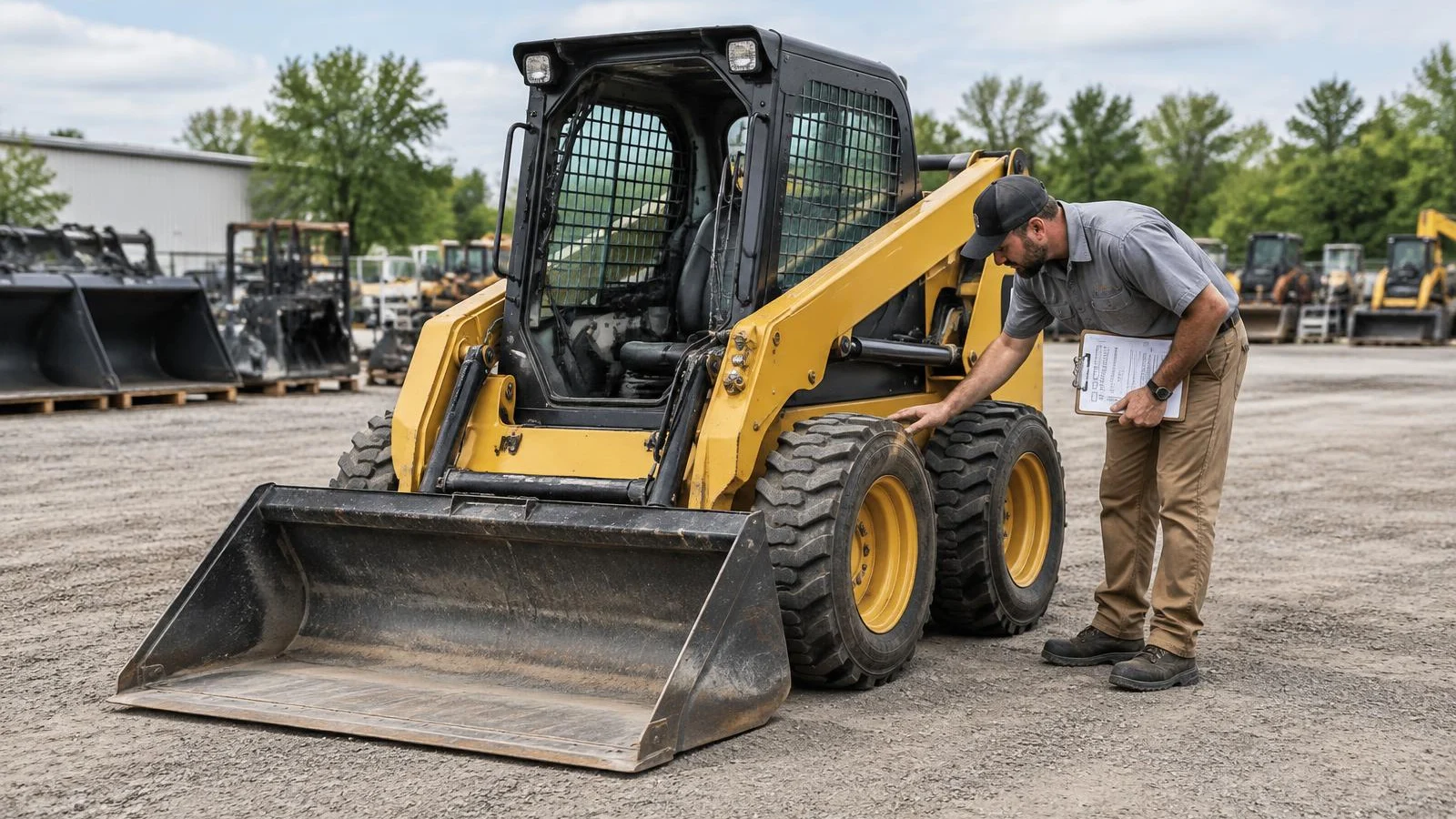
Before buying a used skid steer, verify the machine’s identity, compare its hours with dated service records, inspect its tires and attachment interface, and have its drive system and hydraulics demonstrated. Then add the immediate repair and delivery costs to the asking price.
A useful inspection produces evidence you can compare. “Runs well” gives you little to work with. A serial-number photo, dated service invoice, operating demonstration, and written repair estimate help you decide whether the machine fits your job and budget.
This checklist focuses on wheeled skid steers: in this article, “skid steer” means a machine with tires, distinct from a compact track loader (CTL). If you are considering a compact track loader, add a dedicated undercarriage assessment. Our skid steer vs. compact track loader comparison explains how the ground you work on affects that choice.
1. Confirm the machine fits your work
Write down your most frequent job, typical ground conditions, narrowest access point, and heaviest regular load before you browse skid steers for sale. Include the attachment you need for that job.
For pallet handling, record the pallet weight and dimensions, placement height, and how far the load must reach. For powered attachments, identify required hydraulic flow, pressure, connections, and controls. For work inside a building, check doorway height and width against the actual machine.
Bring those details to the seller. Ask for the manufacturer’s specifications for the exact model and configuration, including rated operating capacity, operating weight, and overall dimensions. Verify capacity for the intended attachment and working conditions.
A good inspection can still lead to a poor purchase if the machine cannot run your attachment, fit your site, or travel on your trailer.
2. Request the evidence before arranging a visit
Ask for one organized set of information. This helps you compare candidates and shows which questions remain open.
| Request | What it helps establish | Follow-up if missing |
|---|---|---|
| Full model and serial-number photo | Identity and applicable documentation | Ask for a clear close-up before committing |
| Current hour-meter photo | Displayed reading at a known point | Record the date and whether the meter was replaced |
| Dated service and repair records | Maintenance history and documented work | Ask which periods or owners are undocumented |
| Tire photos from both sides | Size, type, damage, and visible wear | Request close-ups of sidewalls and wheel rims |
| Attachment list and mounting photos | What is included and how it connects | Get a written inclusion list |
| Cold-start and operating demonstration | Behavior from startup through working temperature | Agree what can be demonstrated before visiting |
| Known-fault statement | Seller’s disclosed outstanding issues | Request explanations and repair estimates |
| Configured weight and dimensions | Transport planning | Confirm what the figures include |
Keep a simple status beside each item — received, needs clarification, or missing. Missing records increase uncertainty. Decide how that uncertainty affects your inspection plan and acceptable price.
3. Match the identity, meter, and history
Compare the serial number on the machine with the sale paperwork, service documents, and any inspection report. Ask the seller to explain an unreadable plate or inconsistent identifiers before paying. Confirm that the selling party has authority to sell the equipment and resolve any ownership or finance questions through appropriate local checks.
Treat the meter as one piece of the history. Ask whether it is original, has been replaced, or has a documented interruption. Compare dated readings on invoices with the current display. If the model supports electronic operating records, ask an authorized technician whether they can provide relevant information.
Calculate use between two reliable records. For example, an invoice showing 1,850 hours and a current reading of 2,450 hours represents 600 displayed hours between those dates. Ask what work the loader performed during that interval.
A machine used mainly for yard loading can have a different wear pattern from one running a demanding powered attachment. Ask about previous applications, owners, storage, and major repairs.
Request documentation for any rebuild. Find out which components were repaired, who did the work, and whether the invoice identifies the machine.
4. Inspect tires, wheels, frame, and attachment mounting
Start with the machine parked securely, the bucket lowered, and the engine stopped as required by the manual. Photograph concerns so they can be discussed with the inspector and priced.
On a wheeled skid steer, look for tire cuts, sidewall damage, uneven wear, and differences between tires. Record sizes and types. Pneumatic, foam-filled, and solid options affect replacement planning and operation. Ask whether the installed combination is approved for that model.
Inspect rims and visible wheel hardware for damage. Have unexplained uneven wear assessed before assuming a fresh set of tires will resolve it.
Look over the frame, lift arms, pivots, bucket, and attachment plate. Note cracks, distortion, unusual welds, loose components, and recent paint around repairs. Ask for the repair history and any applicable manufacturer documentation where structural work is involved.
Check the attachment’s cutting edge, floor, sides, and mounting points. Include its condition in the price comparison if it comes with the machine. Bobcat’s maintenance guidance includes tires, leaks, and attachment couplers among the inspection areas. Bobcat loader service and maintenance guidance.
5. Compare maintenance records with the correct schedule
Use the service schedule for the exact model and serial range. Review what should have been completed by the displayed hours and calendar age, then ask for the corresponding records.
Separate completed maintenance from work the seller plans to do. Record whether fluids, filters, belts, cooling components, and drive-system service are documented where applicable. Ask what was found during the most recent service and whether any recommendations remain outstanding.
Bobcat publishes model-specific schedules and directs owners to the operation and maintenance manual for procedures. Use the same model-specific approach with any brand. Bobcat service schedules.
From a safe position, look for fluid accumulation, damaged hoses, abrasion, cooling-pack debris, and loose or damaged components. Have the technician identify the source of any leak and whether cleaning is needed to trace it.
Ask how the machine behaves once warm and whether it has recorded warnings, overheating events, or repeated repairs. Keep a photo of the display and request an explanation of active warnings. Bobcat’s loader maintenance guidance includes checks of leaks, tires, attachment couplers, fluids, and drive components. Bobcat loader service and maintenance guidance.
6. Arrange a controlled operating demonstration
Have a qualified operator demonstrate the loader in a suitable area. Agree on the sequence beforehand so a short video or visit answers your actual questions.
Request a cold start where practical, then observe the display, starting behavior, unusual sounds, and any warnings. After the machine reaches its normal operating condition, have the operator demonstrate forward and reverse travel, turns in both directions, lift, tilt, and the auxiliary functions relevant to your work.
Record persistent hesitation, pulling, vibration, unusual noise, or changing behavior as the machine warms. Ask the inspector to investigate those observations. A symptom can have several causes, and a demonstration alone may leave repair costs uncertain.
If the purchase depends on running a particular attachment, arrange an appropriate demonstration with that attachment or obtain a documented compatibility assessment. Lifting an empty bucket provides limited evidence about the machine’s behavior during your intended work.
Ask the inspector for written findings, recommended follow-up, and the scope of any testing performed. An inspection report is more useful when it distinguishes observations from measurements and identifies anything that could not be checked.
7. Include safety equipment in the purchase decision
Have the operator or technician verify the seat belt, restraint system, interlocks, protective structures, screens, and other fitted safeguards using the manufacturer’s procedures. A disabled interlock or damaged protective structure needs resolution before the machine enters service.
Keep lift-arm support equipment and the applicable manual on your inspection list. Work around raised arms requires the manufacturer’s specified support and procedure. Hydraulic pressure alone cannot be relied on to keep the arms raised. NIOSH specifically identifies lift-arm supports, interlocks, restraints, and protective structures as safeguards that must be maintained. NIOSH guidance on skid-steer loader injuries and safeguards.
For a buyer, the practical question is whether the machine arrives with its required safeguards intact and functioning. Obtain a repair plan and cost for unresolved items before treating the loader as ready to work.
8. Verify attachment fit and local support
List each attachment by make and model, including anything you already own. Confirm the mounting interface, locking arrangement, weight, hydraulic requirements, couplers, and electrical controls.
Ask whether the machine is equipped with standard-flow or high-flow hydraulics and verify the actual specification. Check case-drain requirements where the attachment calls for one. Get compatibility confirmed for the exact loader and attachment combination.
Also check parts and service availability at the destination. Ask a local supplier about filters, tires, hoses, coupler parts, and support for the model’s drive and electronic systems. Find out which repairs can be handled locally and which require specialized equipment or a service visit.
For a remote purchase, request a continuous walkaround identifying the machine and showing the functions you agreed to review. Consider an independent inspection near the seller. Our guide to buying equipment online safely covers seller verification, written terms, and payment checks that apply to loader purchases too.
9. Compare the cost to get each machine working
Add known immediate costs to each asking price before comparing candidates. Keep unresolved repairs visible as open questions.
The figures below are hypothetical USD examples. Replace them with written quotes in your currency.
| Cost item | Machine A | Machine B |
|---|---|---|
| Asking price | $24,000 | $27,500 |
| Immediate tire replacement | $2,200 | $0 |
| Documented repair estimate | $1,600 | $400 |
| Service due before work | $700 | $500 |
| Delivery quote | $900 | $900 |
| Total identified starting cost | $29,400 | $29,300 |
Machine A’s lower asking price produces a slightly higher identified starting cost in this example. Both still need evaluation of the remaining uncertainty, attachment fit, support, and future maintenance.
Include taxes, import charges, inspections, unloading, and other destination costs where applicable. If a drive-system concern has no diagnosis, mark it unresolved and obtain an assessment before assigning a repair allowance.
Ask whether quoted repairs include labor, parts, transport to the workshop, and any follow-up checks. For a working business, consider the value of the time the machine will be unavailable.
10. Make the decision with an evidence worksheet
Finish the inspection by assigning each important finding an action.
| Finding | Evidence to retain | Action before purchase |
|---|---|---|
| Tire replacement due | Photos and local quote | Include installed replacement cost |
| Coupler concern | Inspector’s findings | Confirm repair scope and attachment security |
| Intermittent warm-operation symptom | Video and diagnostic report | Resolve cause and likely cost |
| Missing service period | Available records and seller explanation | Decide what further inspection is needed |
| Attachment compatibility uncertain | Loader and attachment specifications | Obtain confirmation |
| Delivery access uncertain | Dimensions, weight, and site details | Confirm unloading arrangement |
Proceed when the machine fits the work, identity and sale terms are clear, and known costs are acceptable. Negotiate using documented findings. Pause when an unresolved issue could materially change safety, suitability, or ownership cost.
Keep the final attachment list, repair agreement, and delivery terms with the sale documents.
Frequently asked questions
How many hours are too many on a used skid steer?
There is no useful universal cutoff. Compare the reading with maintenance records, previous applications, repairs, and the machine’s current condition. Use a qualified inspection to assess expensive components and unresolved symptoms.
Should I buy a used skid steer without service records?
Assess the missing history as additional uncertainty. Request the records that do exist and decide what inspection or diagnostics would help. Price the machine with the known condition and remaining gaps in view.
What should a remote seller show in a video?
Request identification, the meter and display, both sides of the machine, tires, attachment mounting, and a controlled operating sequence. Ask for close-ups of any known concerns and confirm when the video was recorded.
Does a high-flow hydraulic option mean my attachment will work?
Confirm the attachment’s required flow, pressure, connections, controls, and weight against the exact machine. A high-flow label is only part of the compatibility check.
What information should I send when requesting a quote?
Include the listing or machine identifier, intended work, heaviest load, required attachments, and delivery destination. Mention access or unloading constraints. You can request a quote for a shortlisted skid steer with those details and ask for the available records and inspection information before deciding.