
Equipment buying guides
Tractor Attachments for Small Acreage — What to Buy First
Affordable Tractors & Equipment
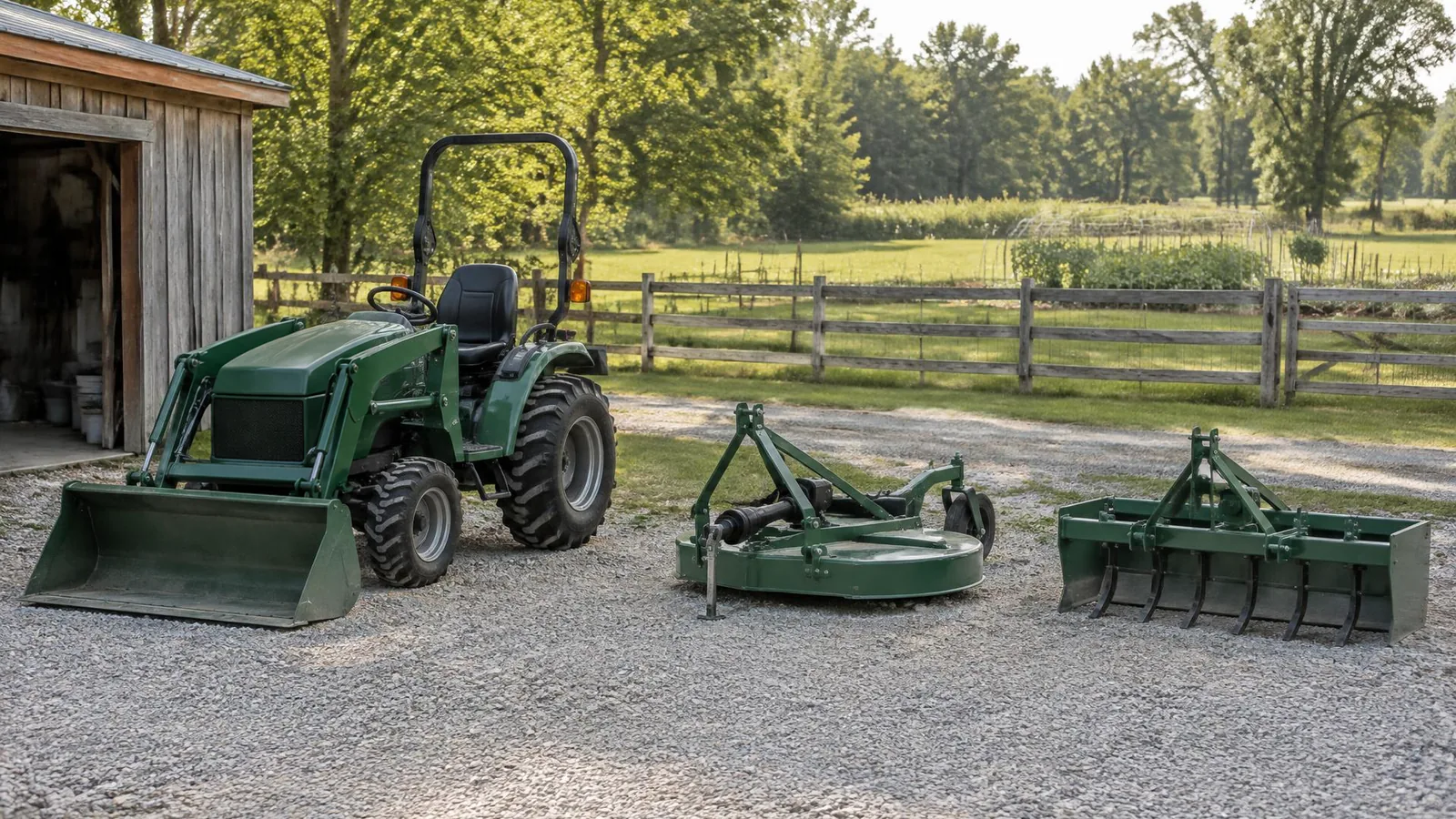
The first tractor attachments to consider are the ones that solve your most frequent jobs. For a property with rough grass and a gravel lane, that may mean a rotary cutter and a grading implement. For garden beds and regular deliveries, a tiller and pallet forks may deserve priority. A front loader can serve many material-handling tasks, provided the tractor, loader, attachment, and ballast are matched.
Before buying, check the attachment against the exact tractor. Mounting type, available power, implement weight, lift geometry, hydraulic requirements, and operating clearance all affect whether it will work.
Use this guide to build a practical shortlist. The examples describe attachment types. Ask about availability and confirm fit before treating any example as a purchase recommendation for your machine.
Start with the work your property creates
A 10-acre property is approximately 4 hectares, but two properties that size can need very different equipment. One may have maintained lawn, a small garden, and a short driveway. Another may have rough pasture, a long gravel lane, and regular fencing work.
Record the area or distance you actually maintain, how often you work it, and what slows you down. Note slopes, wet ground, narrow gates, trees, storage space, and where materials arrive.
| Recurring job | Attachment to investigate | Key question before buying |
|---|---|---|
| Maintained grass | Finish mower or suitable mowing deck | What finish, clearance, and maneuverability do you need? |
| Rough grass and light brush | Rotary cutter | What material is the exact cutter rated to handle? |
| Gravel-lane maintenance | Land plane, box blade, or rear blade | Are you smoothing, moving material, or reshaping drainage? |
| Garden-bed preparation | Rotary tiller | Does its power requirement and weight suit the tractor? |
| Loose material handling | Loader bucket | Is the material volume within the configured loader’s limits? |
| Pallet handling | Approved pallet-fork attachment | Can the machine handle the load at the required reach and height? |
| Brush collection | Suitable grapple | Are the mounting interface and hydraulic controls compatible? |
If you are still choosing the tractor, bring this job list when comparing compact tractors for property work. Our tractor sizing guide for 5–20 acres helps connect the machine choice to tasks, access, and implements.
Mowing equipment should match the vegetation
A finish mower suits maintained grass where the quality of the cut matters. A rotary cutter is intended for rougher vegetation within its published limits. Decide what you will cut before choosing deck width.
John Deere’s equipment guidance distinguishes the finish produced by a grooming mower from the rougher vegetation work associated with a rotary cutter. John Deere MachineFinder’s rotary-cutter explanation.
For a rotary cutter, check the exact model’s vegetation rating, required tractor power, PTO speed, hitch, weight, and guarding. Identify whether the power specification refers to engine horsepower or PTO horsepower. A tractor’s engine rating and its available PTO power are different figures.
Width affects time, access, and turning. A wider implement may cover open ground faster while becoming awkward between trees or through a narrow gate. Also consider where it will be parked and how you will connect it.
Here is an illustrative mowing calculation. Assume a 1.2 m working width, 4 km/h travel speed, and 65% field efficiency to allow for overlap and turning. Estimated coverage is:
1.2 × 4 × 0.65 ÷ 10 = 0.312 hectares per hour.
At a 1.5 m width with the same assumptions, estimated coverage becomes 0.390 hectares per hour. Covering 2 hectares, approximately 4.9 acres, would take about 6.4 hours or 5.1 hours respectively.
Those are planning estimates. Dense vegetation, obstacles, terrain, and the tractor’s ability to maintain an appropriate working speed can change the result. Confirm that the wider cutter is a suitable match before expecting the time saving.
Choose a grading implement for the work it must do
For a gravel lane, begin by identifying the problem. Loose surface material, recurring potholes, drainage trouble, and a worn-out gravel layer call for different work.
A land plane is worth investigating for routine smoothing and redistributing loose surface material. A box blade can collect and move material, with scarifiers on suitably equipped models to loosen the surface. A rear blade can move material to one side and help shape an edge when its adjustment range and the tractor’s setup suit the job.
Land Pride describes its BB12 box scrapers for ripping, leveling, finish grading, and backfilling, with adjustable shanks and cutting blades. That is one documented product family, so confirm specifications for the actual implement offered. Land Pride BB12 box-scraper literature.
Consider width, weight, hitch fit, and available traction together. A wide box blade filled with material can demand more traction than a light smoothing pass. Match the implement to the tractor’s published limits and the ground you will work.
Investigate the cause of recurring damage too. Smoothing a pothole may improve the surface temporarily while water continues to collect in the same place. Include drainage assessment and any necessary replacement material in the job plan.
A tiller makes sense when soil preparation repeats
A rotary tiller can be useful for recurring garden-bed or seedbed preparation. First record the width of the beds, entry points, soil condition, and how often you will prepare them.
Compare working width with overall width. The working width describes the strip being tilled. The overall width determines whether the implement fits through a passage or into storage. Check whether an approved offset arrangement is available if covering a wheel track matters.
Land Pride’s RTA12 specifications illustrate why exact models matter. The sheet lists model-dependent recommended PTO power, weight, working width, and overall width. Its RTA1250 example has a working width of 1.27 m, about 50 inches, and a greater overall width. Use the applicable serial-range documentation for the implement you are considering. Land Pride RTA12 specification sheet.
Soil and workload also matter. Preparing an established garden differs from breaking compacted or stony ground. Explain those conditions to the supplier when checking fit.
If you prepare a small garden once a year, compare ownership with hiring the job or renting suitable equipment. Include delivery, setup, maintenance, and storage in that comparison.
A bucket, forks, and grapple solve different handling jobs
A general-purpose loader bucket can move loose soil, gravel, compost, and similar materials within the configured machine’s limits. Material density affects load weight. The same bucket volume can represent different loads when filled with different materials.
Pallet forks deserve consideration when you regularly receive bagged supplies or palletized materials. Record the load’s weight, dimensions, center of gravity, required placement height, and how far forward it must reach. Ask for the applicable capacity guidance for the tractor, fitted loader, and fork attachment.
For example, a hypothetical 500 kg pallet and 100 kg fork assembly total 600 kg, about 1,323 lb. That arithmetic describes the combined mass. The dealer still needs the load position, reach, height, and exact equipment to assess the lift.
A grapple can help with brush collection, but its weight consumes part of the configured loader’s available capacity. Confirm the mounting interface, auxiliary hydraulic function, couplers, hose routing, and control arrangement.
Compare approved ballast requirements for the intended loader work. Front and rear ballast must be selected for the tractor and implement combination, with tire, axle, and operating limits taken into account. John Deere’s compact and utility tractor guidance explains the role of ballast when using loaders and rear implements. John Deere ballast guidance.
Check compatibility before comparing prices
Use a short evidence sheet for every shortlisted implement.
| Item | Information to confirm |
|---|---|
| Tractor identity | Exact model, transmission, tire setup, loader, and relevant options |
| Hitch or loader mount | Category or interface, dimensions, and approved compatibility |
| Power | Required power basis, available PTO power, and specified PTO speed |
| Weight and geometry | Implement weight, center of gravity, lift clearance, and transport position |
| Hydraulics | Required flow, pressure, functions, couplers, and controls |
| Driveline | Applicable PTO shaft, shielding, length, and movement through the approved range |
| Ballast and limits | Manufacturer requirements for the complete combination |
| Included equipment | Pins, couplers, hoses, shaft, stands, and any required adapters |
A Category 1 hitch is an important starting point, but lift height and physical clearance still need checking. A long or heavy implement can create a different lifting demand from a compact load near the linkage.
A quick hitch can make frequent changes easier. Confirm compatibility with each implement and how it affects clearance and driveline fit. Land Pride’s quick-hitch literature identifies model-specific applications and notes that PTO-driven implements may require driveline changes. Land Pride quick-hitch guide.
For PTO equipment, have the driveline checked when changing tractors or switching hitch arrangements. The applicable Land Pride driveline guidance explains that an excessively long shaft can bottom out and damage equipment. Use the actual implement’s manual and approved setup procedure. Land Pride driveline setup guidance.
Our compact vs. subcompact tractor comparison also explains why similar horsepower figures can accompany different physical capabilities.
Build your first attachment set around recurring work
For rough grass and a gravel driveway, investigate a compatible cutter and one grading implement. Choose the grading tool after deciding how much material you need to move and whether drainage reshaping is part of the job.
For a garden and regular supply deliveries, investigate a suitable tiller and approved forks. Verify bed access and the heaviest delivery load before selecting models.
For landscaping and frequent brush collection, compare the bucket’s capability with the jobs that would justify a grapple. Include the hydraulic equipment and ballast required to operate it.
These examples help organize a shortlist. Purchase order should follow your workload, budget, and the confirmed tractor configuration.
A useful first season can also reveal what deserves a later purchase. Record how often a task occurs, how long it takes, and what equipment you borrow or hire. That gives you a basis for deciding whether another implement will earn its storage space.
Compare total cost and frequency of use
Include the implement, setup, required controls, compatible driveline, ballast, delivery, and storage arrangements when comparing ownership cost.
Suppose a hypothetical implement costs USD 1,800. Setup and delivery add USD 300, and it is later sold for USD 900 after five years. The purchase, setup, and delivery cost less resale is USD 1,200 over that period.
At 12 uses per year, that is 60 uses, or USD 20 per use before maintenance, tractor operating cost, financing, and storage. At three uses per year, it becomes USD 80 per use before those additional costs.
Compare those figures with actual rental or contractor quotes for the same work. Consider availability during the season when you need the equipment.
Buying used can change the calculation. Inspect wear parts, gearboxes where fitted, hydraulic components, guards, hitch points, and included accessories. Ask which replacement parts are available locally and price missing components before committing.
Confirm what is available and included
You can browse the implement listings and check the attachment listings to see what is currently offered. Read each listing’s specifications and request confirmation for your tractor. Categories may contain equipment for several machine sizes and applications.
Ask whether the quoted price includes the mounting equipment, PTO shaft, hoses, couplers, stands, or other required parts. For a tractor-and-loader listing, get the included bucket and any additional implements identified in writing.
Send the tractor model, fitted loader, task list, desired working width, and delivery destination when you request a tractor and attachment quote. Include any attachment you already own. That makes it easier to assess the complete combination and identify equipment or setup still required.
Frequently asked questions
What tractor attachment should I buy first for a small property?
Start with the job you perform most often. Rough mowing may point to a cutter, driveway work to a grading implement, and repeated material handling to a suitable loader attachment. Verify fit before buying.
Will a wider implement always save time?
It can improve coverage on open ground when the tractor can operate it appropriately. Access, obstacles, power, traction, and turning space can reduce that advantage. Compare expected working conditions as well as width.
Can I use a skid-steer attachment on a tractor loader?
Check the exact mounting interface and manufacturer-approved compatibility. Also verify attachment weight, hydraulic requirements, controls, and loader capacity for the intended work.
Does a quick hitch make every three-point implement compatible?
Check each implement. Hitch dimensions, top-link arrangement, lift clearance, and PTO driveline fit can affect compatibility. Use the manuals for the tractor, hitch, and implement.
Should I buy all my attachments with the tractor?
Buying together can make compatibility and delivery planning easier. Prioritize confirmed recurring jobs, and get a written list of the complete package. Later purchases can follow the workload you actually experience.