
Tractor Buying Guides
Compact vs. Subcompact Tractors: Which Should You Buy?
Affordable Tractors & Equipment
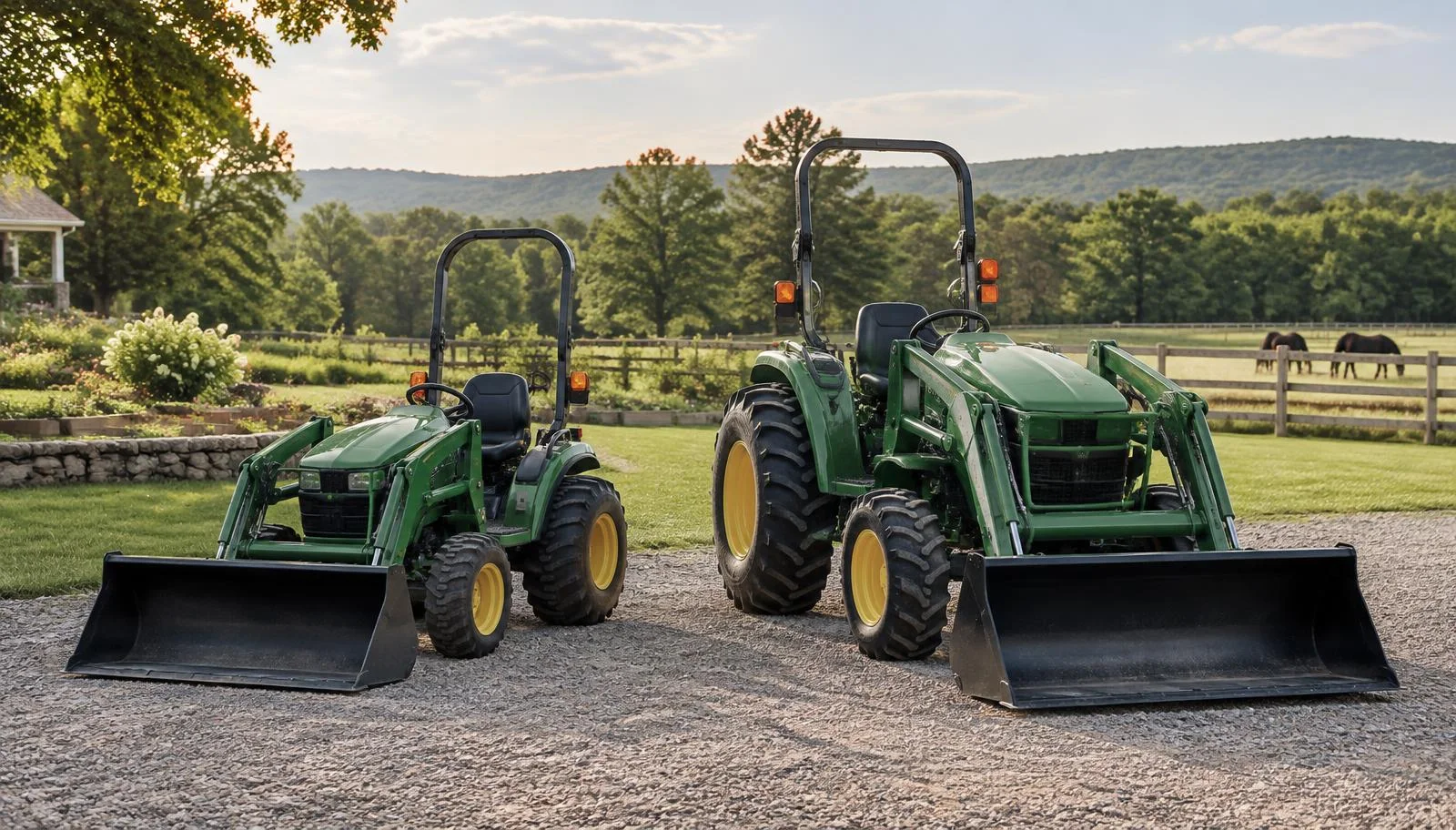
A subcompact tractor is generally the smaller property-maintenance option, while the compact category covers a broader range of machine sizes and capabilities. But the category name alone does not establish whether a tractor fits your gate, handles your implement or meets your loader requirements.
Choose by the exact equipment package: tractor, tires, loader, attachments and documented operating limits. Similar horsepower does not mean similar dimensions, and a larger machine is not automatically the better purchase.
Start by comparing compact and subcompact tractors, then eliminate candidates that fail your essential requirements.
What is the difference between compact and subcompact?
Manufacturers use these labels to organize their ranges, but the boundaries are not a universal buying formula.
For example, Kubota places its BX range in the subcompact category and its B01 range among compact tractors. Both are offered for property work, but their individual configurations differ. Kubota BX range, Kubota B01 range
A useful comparison looks like this:
| Decision area | What the category suggests | What you must compare |
|---|---|---|
| Physical size | Subcompact is generally the smaller starting point | Actual width, height, length and fitted equipment |
| Power | Compact ranges can offer more options | Engine and PTO power of the exact model |
| Implements | Both categories can support multiple jobs | Mounting, power, hydraulics, weight and clearance |
| Loader work | Capability varies by tractor and loader | Applicable capacity, measurement point and height |
| Ownership | Different equipment packages create different costs | Complete purchase, support and maintenance requirements |
Use the label to find candidates. Use specifications and your work requirements to choose between them.
Similar horsepower can hide important differences
Consider this manufacturer-brochure example:
| Specification | Kubota BX2380 | Kubota B2301HSD |
|---|---|---|
| Category in the cited range | Subcompact | Compact |
| Engine gross horsepower | 21.6 hp | 20.9 hp |
| PTO horsepower | 17.7 hp | 17.5 hp |
| Hydrostatic transmission | Two ranges | Three ranges |
Sources: Kubota US BX brochure, ©2017 and Kubota US B01 brochure, ©2020.
These are specifications from those publications, not a current-stock comparison. Confirm the applicable year, market and configuration before using them for a purchase.
The figures show why “more horsepower means a bigger class” is unreliable. These two examples have similar power figures, yet belong to different manufacturer categories and have different transmission configurations.
That does not establish a winner. It establishes which comparisons are still needed: dimensions, implement fit, loader requirements and the work you expect to perform.
Compare physical fit before optional features
A tractor that cannot reach or be stored where you need it is a poor fit, regardless of its specification advantages elsewhere.
Measure the narrowest gate, storage opening and restricted working route. Compare those measurements with the actual machine, including its tires, loader, bucket, mower or other fitted equipment.
Do not compare a tractor-only width with a gate while overlooking a wider attachment. Likewise, a published tractor length may use a configuration different from the package being offered.
Prepare a route checklist:
- Where must the tractor enter?
- Where must it turn?
- What attachments will be fitted on that route?
- What overhead restrictions exist?
- What changes between working and stored configurations?
A measured opening is not a recommended clearance margin. Turning space, uneven ground and obstructions also need consideration.
If a candidate only appears to fit under an assumed configuration, resolve that assumption before buying.
Mowing: compare the setup, not just the tractor
For mowing, establish whether the package uses a mid-mounted mower, rear mower or another arrangement. Confirm that the exact mower, mounting hardware, PTO and lifting arrangement are compatible.
Massey Ferguson’s subcompact specifications, for example, separately list engine power, PTO power, hitch capacity and base weight. Those are distinct parts of an equipment comparison—not interchangeable measures of mowing suitability. Massey Ferguson subcompact specifications
Also consider where the mower must work: open ground, gates, trees, buildings and storage. A wider mower may offer greater theoretical coverage, but that benefit matters only if the equipment fits the work area and is appropriate for the tractor.
A worked mowing-time example
Effective field capacity can be estimated from working width, speed and field efficiency. Iowa State provides a tool for exploring these relationships. Iowa State field-capacity planning
Consider an illustrative two-hectare area, approximately 4.94 acres. Assume:
- Travel speed: 4 km/h, approximately 2.5 mph.
- Field efficiency: 65%.
- Working widths: 1.2 metres and 1.5 metres.
| Illustrative setup | Estimated effective capacity | Estimated time for two hectares |
|---|---|---|
| 1.2-metre working width | 0.312 hectares/hour | 6.4 hours |
| 1.5-metre working width | 0.390 hectares/hour | 5.1 hours |
Calculation: width in metres × speed in km/h × efficiency as a decimal ÷ 10.
The difference is approximately 1.3 hours under these assumptions. This is not a tested performance claim or a statement that either tractor class supports a particular mower.
Use the calculation to understand a tradeoff. Then verify equipment compatibility, realistic conditions and whether the wider setup can actually serve the whole area.
Loader work: read the measurement behind the number
Loader capacity, rear hitch capacity and breakout force describe different things.
A rear hitch rating concerns the rear lifting system. A loader rating must identify the relevant loader, configuration, load position and lifting height. Breakout force is not a substitute for a load-carrying rating.
Kubota’s cited BX brochure illustrates the importance of these labels by presenting loader ratings at different measurement points and distinguishing them from breakout force. Kubota BX equipment specifications
When comparing packages, write down:
- Exact tractor and loader model.
- Bucket, forks or other proposed attachment.
- Intended material or load.
- Required placement height.
- Rating basis and applicable restrictions.
- Required configuration and ballast.
Do not compare the largest numbers on two advertisements unless they describe the same measurement. Have the proposed package checked against the relevant manuals rather than assuming the category name establishes its capability.
PTO and hydraulics: identify the actual requirement
PTO means power take-off: a means of transmitting tractor power to a compatible powered implement.
Check the implement’s required PTO speed and power against the exact tractor specification. Engine horsepower is not a substitute for PTO horsepower.
Hydraulic equipment adds another comparison. Establish the required flow, pressure, outlets and controls from the applicable documentation. A headline pump-output number should not be assumed to describe everything available to an attachment.
In the B01 brochure example, transmission and PTO arrangements differ across models within the same series. That is another reason to identify the exact configuration rather than treating a series name as a complete specification. Kubota B01 configuration information
If you already own an implement, bring its model number into the purchase discussion before narrowing the tractor shortlist.
A hitch category is a starting point, not complete compatibility
Two listings that mention Category I do not automatically establish that every attachment can be transferred between them.
Compare the actual mounting arrangement, lifting requirement, available movement, PTO connection where applicable and manufacturer compatibility information.
For example, John Deere labels the rear hitch of its 1M 25 subcompact as Limited Category 1. That wording should prompt an exact implement-fit check rather than an assumption based on the word “Category.” John Deere 1M 25 specifications
Build an attachment list with three columns:
- Already owned.
- Included with the tractor.
- Needed separately.
Then establish compatibility for each item. This often reveals a more meaningful difference between offers than horsepower alone.
Consider changeovers and storage as part of the package
A tractor may perform several jobs, but the usefulness of that versatility depends on how the equipment works together.
Ask which components are needed to change from mowing to loader or rear-implement work. Confirm that required stands, mounts, linkages, couplers and other hardware are actually included.
Also plan where removed equipment will go. A package with several attachments needs storage for more than the tractor.
Instead of accepting “quick attach” as a complete answer, identify what the system connects, what remains manual and whether the machine offered includes the necessary parts. Do not assume systems from different manufacturers or model years are interchangeable.
These details matter especially when comparing a complete smaller package against a larger tractor sold with fewer accessories.
Weight, ground conditions and terrain need separate attention
Do not turn “smaller” into a guarantee of turf protection or “larger” into a guarantee of traction and stability.
Cornell’s tractor-selection guidance treats weight, frame size and horsepower separately and discusses how an equipment mismatch can affect access, ground conditions and the work performed. Cornell Small Farms tractor-selection guidance
Record the actual configuration weight, tires, fitted implements and the property conditions that need assessment.
Base tractor weight is not necessarily the weight of a complete working or transport package. A loader, attachment and ballast can change what must be considered.
There is no universal slope recommendation in this comparison. Use the applicable operator guidance and an appropriate assessment of the machine and property rather than choosing a class because someone describes it as “more stable.”
Three buyers, three different comparisons
These are hypothetical planning examples, not customer experiences.
Buyer A: lawn, garden and narrow access
This buyer maintains a lawn, vegetable garden and short driveway. Storage and access are restrictive.
A smaller package belongs on the shortlist if its mower, rear implement and loader capabilities meet the requirements. A compact also deserves consideration if a specific job requires it and the actual package fits.
The first comparison is access and equipment suitability—not whether extra horsepower is available.
Buyer B: recurring pasture and implement work
This buyer needs regular field maintenance and already owns an implement.
Begin with that implement’s documented requirements, then compare working time, physical fit and support. A larger candidate is useful only if its additional capability addresses the actual requirement.
Buyer C: occasional digging project
This buyer mainly needs routine property maintenance but also has a one-time digging task.
Compare the complete tractor/backhoe package with a tractor selected for recurring work and a separately arranged solution for the occasional project. This is an ownership decision framework, not a claim that ATE provides rental or contracting services.
Frequency matters: a rare job should be considered explicitly rather than silently determining the entire purchase.
Compare complete ownership costs
Use the same scope when comparing quotations. A smaller tractor with a loader and mower should not be compared only on price with a larger tractor that excludes both.
| Cost or requirement | What to establish |
|---|---|
| Tractor configuration | Exact model, transmission and fitted equipment |
| Implements | Included items and separately needed equipment |
| Compatibility | Any additional mounting or connection components |
| Condition | Known faults and documented work required |
| Maintenance | Applicable schedule and available history |
| Delivery | Actual package and destination-specific quotation |
| Support | Parts and qualified service where the machine will operate |
| Storage | Space for the tractor and removed attachments |
Keep every price in its stated currency and distinguish known quotations from estimates.
If buying used, use our used tractor buying checklist. For uncertainty about operating history, our used tractor hours guide explains how to evaluate the evidence.
Use a shortlist worksheet
Mark each requirement as confirmed, unresolved or unsuitable. Do not award points that allow a failed essential requirement to disappear inside an overall score.
| Requirement | Candidate A | Candidate B |
|---|---|---|
| Fits access and storage in the intended configuration | ||
| Supports existing and proposed implements | ||
| Meets documented PTO and hydraulic requirements | ||
| Meets the actual loader task requirements | ||
| Provides a workable mowing or maintenance setup | ||
| Has necessary mounting and changeover hardware | ||
| Has acceptable condition and history evidence | ||
| Has support available at the destination | ||
| Fits the complete budget |
Eliminate an unsuitable candidate, resolve material unknowns and compare the remaining offers.
For help defining the underlying jobs and maintained area, see our tractor sizing guide for 5–20 acres.
Frequently asked questions
Is a compact tractor always more powerful than a subcompact?
No. Manufacturer categories and individual power figures can overlap. Compare the exact engine and PTO specifications rather than using the label as a horsepower guarantee.
Can a subcompact tractor use a loader and rear implements?
Many are offered with those capabilities, but the exact loader, mounting arrangement, ratings and implement requirements must match. A photograph or category name does not establish compatibility.
Is a subcompact enough for five acres?
Acreage alone cannot answer that. Five acres of lawn and garden presents a different requirement from five acres of regularly worked ground. Compare the jobs, implements, time available and access.
Should I choose the largest tractor I can afford?
Choose a package that meets your actual requirements. Additional capability has value when you need it; it does not compensate for poor access, unsuitable attachments or an incomplete equipment budget.
Are compact tractors better for loader work?
Compare the specific loader packages and documented ratings. Do not infer load suitability from class, engine horsepower or breakout force alone.
Can I move my existing attachments to the new tractor?
Only after confirming compatibility. Identify each attachment and compare mounting, power, hydraulics, weight, clearance and manufacturer requirements before purchase.
Is new subcompact versus used compact a fair comparison?
It can be a useful buying comparison if both meet your tasks and you account for condition, included equipment, maintenance needs, written terms and complete cost. Class and new/used status answer different questions.
Compare equipment for your actual work
Send Affordable Tractors & Equipment your main jobs, maintained area, access measurements, implement models, loader requirements, destination and budget.
Request a tractor quote with any listing links or stock numbers you are considering. Compare the complete configurations rather than deciding from the class name alone.