
Tractor Buying Guides
How Many Hours Are Too Many on a Used Tractor?
Affordable Tractors & Equipment
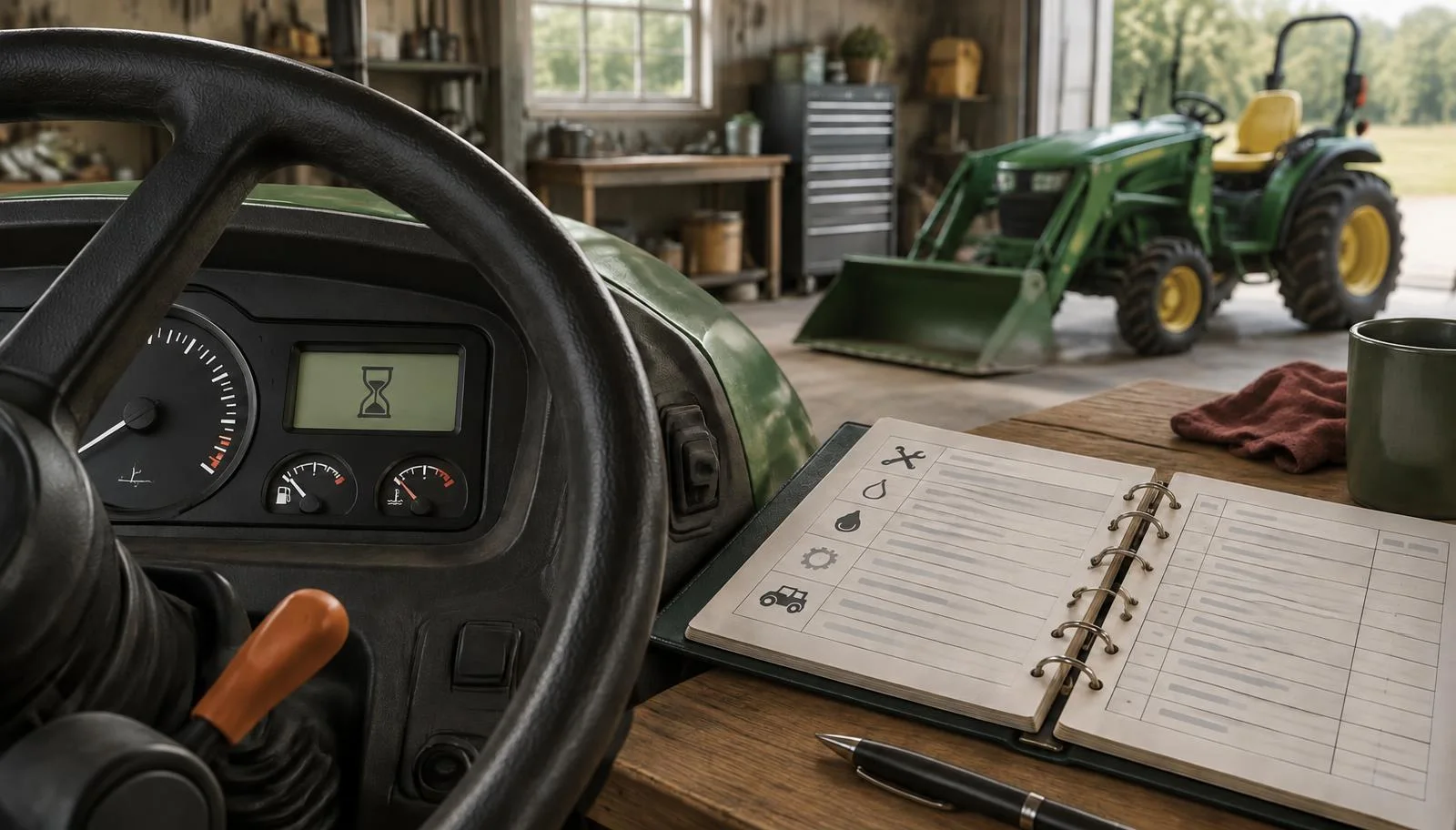
There is no single hour reading that makes every used tractor a good purchase or a bad one. A useful decision combines the displayed hours with the exact model, documented maintenance, previous work, repairs, current condition and the jobs you need it to do.
A tractor with 2,000 hours should not receive an automatic pass or rejection. The important question is what evidence explains those hours—and what costs or uncertainties remain before it can do your work.
When comparing tractors for sale, use hours to organize your investigation rather than make the decision on their own.
What do tractor hours actually measure?
An hour meter records usage according to the machine’s design. Read the applicable operator’s manual to establish what its display represents.
For example, John Deere’s operator guidance for the equipment covered by manual OMLVU25575 describes its hour display as accumulated running hours and a guide for servicing components. That explains the display’s purpose; it does not certify an individual used tractor’s history. John Deere operator guidance
Separate three statements when reading a listing:
- Displayed hours: the number currently visible.
- Reported total hours: the operating history the seller says the machine has accumulated.
- Documented history: records that support a sequence of readings and work.
These statements can agree, but they are not interchangeable. A photograph establishes what a display showed at that moment. It cannot, by itself, explain a replacement meter or periods without records.
Are 1,000, 2,000 or 5,000 hours too many?
None of these numbers is a universal mechanical limit. Treat them as different starting points for questions, not reliability grades.
| Displayed reading | Useful investigation | Conclusion the reading cannot establish |
|---|---|---|
| 1,000 hours | How does the reading fit the machine’s age, records and stated use? | That it needs no repairs or catch-up maintenance |
| 2,000 hours | What service history and condition findings support the offer? | That it has crossed a universal buying cutoff |
| 5,000 hours | Which major components have been assessed, serviced or repaired? | That it is either worn out or proven dependable |
These are example readings, not recommended purchasing bands.
An offer becomes difficult to justify when the unresolved history, condition findings, likely expenditure or downtime do not fit your requirements. That can happen at a low reading as well as a high one.
Instead of asking only, “Is 2,000 hours too many?”, ask, “What would I need to establish before buying this particular machine at this price?”
Put the hours alongside the tractor’s age
Dividing supported total hours by years provides context, not a condition diagnosis.
Consider two hypothetical machines:
| Example | Supported history | Simple annual average |
|---|---|---|
| Tractor A | 1,200 hours over eight years | 150 hours per year |
| Tractor B | 1,200 hours over two years | 600 hours per year |
The arithmetic describes different patterns of use. It does not establish which tractor received better maintenance, how hard either worked or whether use was spread evenly across those years.
Ask about gaps in the timeline. An eight-year average may hide a long period of storage followed by recent use. A two-year average may conceal very seasonal operation.
If total hours or age are uncertain, do not present the calculated average as a verified fact.
Why low hours do not settle the condition question
Low recorded use answers a usage question only when the reading is supported. It does not provide a complete account of storage, service or component condition.
Calendar time also matters. University of Missouri Extension notes that items such as hoses, batteries and tires can deteriorate over time, and that owning machinery creates costs beyond its operating hours. Machinery ownership considerations
For a low-hour candidate, organize your inquiry around:
- Whether the reading represents the machine’s history.
- When it was last used regularly.
- Which services were completed and when.
- Which age-related issues a condition assessment identifies.
- What must be addressed before your intended work.
A low reading may still be attractive. The mistake is treating it as a substitute for the rest of the information.
Evaluate the work behind the hours
Ask what the tractor did, with which implements, in what environment and under whose maintenance arrangements.
Wisconsin Extension explains that operating conditions affect maintenance needs: dust, temperature and the type of work belong in the service discussion. It also recommends using the applicable manual and obtaining help with a pre-purchase assessment. Tractor maintenance planning
Translate a vague answer into something you can evaluate:
| Seller’s description | Useful follow-up |
|---|---|
| “Only used around the property” | Which tasks, implements and maintenance records? |
| “Mostly loader work” | Which loader and attachments, and what repair information is available? |
| “Farm use” | Which seasonal operations and service arrangements? |
| “Recently serviced” | What work, on what date, at which reading, with what documentation? |
Do not rank these descriptions as automatically easy or hard use. Their value is in directing the records and assessment you need.
Read maintenance history as a timeline
A folder of invoices is useful only after you connect the documents to the machine and understand what they cover.
Build a simple sequence:
| Record | Date | Hours shown | Machine identity | Work described |
|---|---|---|---|---|
| Earlier service invoice | Record actual date | Record reading | Confirm matching identification | List documented work |
| Later repair invoice | Record actual date | Record reading | Confirm matching identification | Identify repaired component |
| Current listing | Record observation date | Record display | Match to quotation | Note current disclosed condition |
Check for unexplained differences. If an older invoice shows more hours than the present display, ask whether it concerns another machine, contains an error or reflects a meter change.
Missing records do not prove misconduct. They do limit what you can establish.
Similarly, “regularly serviced” is a statement to clarify. Ask which services were completed, whether the documents identify the tractor and what periods remain uncovered.
Check both hour-based and calendar-based service
Do not assume a tractor has no service due because it has accumulated few hours recently. Manufacturer schedules can include both operating-time and calendar requirements.
For example, John Deere’s guide for specified 6M Final Tier 4 open-station tractors lists hour-based and annual requirements. It also makes an extended engine oil/filter interval conditional on specified oil, filter and fuel requirements. This illustrates why a headline interval should not be copied to another model. John Deere’s model-specific service guide
For the tractor you are considering, establish:
- Which manual applies to its model and configuration.
- What work is documented.
- Whether time-based requirements have also been followed.
- Which services are next due.
- Which items remain unknown.
The outcome should be a machine-specific service picture, not a universal maintenance schedule taken from a buying article.
What if the meter or engine was replaced?
Treat these as two separate events.
A replaced meter: request the replacement date, previous reading if recorded, replacement reading and supporting invoice. Preserve the distinction between a documented total and a seller’s estimate.
A repaired or replaced engine: request the work description and the identity of the machine involved. Establish what was repaired, replaced or reused and whether any written repair coverage applies.
An engine repair does not document the condition of the transmission, axles, hydraulics, loader or the rest of the machine. Do not describe the whole tractor as having the engine’s post-repair hours.
For example, “400 hours since engine work” leaves another question open: what is known about total machine usage?
If the documents do not answer that, keep it unresolved rather than constructing a confident total.
Compare two hypothetical buying offers
Assume both candidates meet your basic equipment requirements.
Candidate A has a lower displayed reading, but no service records supplied and a repair needing further assessment.
Candidate B has a higher supported reading, a documented service timeline and a recent assessment covering the work you expect to perform.
Candidate B has more information supporting the offer. That does not guarantee future reliability or make it the better purchase at any price.
Candidate A may still deserve consideration if its uncertainties can be resolved and the complete cost remains suitable.
This comparison shows why the first sorting step should not be “choose the smaller number.” Compare what each offer establishes and what you would still need to fund or investigate.
Price the known work before comparing the offers
Purchase price is only one part of making a machine ready for your use. Keep documented repair estimates separate from unknown future costs.
The following arithmetic is illustrative only. It does not represent ATE inventory, market prices or typical repair costs.
| Illustrative item, USD | Candidate A | Candidate B |
|---|---|---|
| Asking price | $12,500 | $16,000 |
| Identified pre-use work | $1,800 | $500 |
| Assumed delivery charge | $700 | $700 |
| Subtotal of listed items | $15,000 | $17,200 |
The asking-price difference is $3,500. After these example items, the difference is $2,200.
Now ask what the subtotal excludes: other applicable charges, attachment requirements, additional findings and the impact of downtime. Unknown costs remain unknown; do not hide them inside a precise-looking total.
Missouri Extension distinguishes planned operating expenses from major repairs and discusses downtime and repair-cost uncertainty. A buying comparison should acknowledge those differences rather than imply that all future costs are predictable. Equipment cost planning
Match the purchase to your expected use
An occasional property-maintenance buyer and a business depending on a tractor every working week may assess the same offer differently.
Write down your expected annual usage and consider a simple projection:
- 80 hours annually for five years adds 400 hours.
- 400 hours annually for five years adds 2,000 hours.
These are arithmetic scenarios, not service-life forecasts. Neither tells you how many usable hours remain.
Use them to think about support, planned maintenance and the consequences of an interruption. Ask whether parts and qualified service are available where you will operate the tractor, particularly for an international purchase.
If you have not yet defined the required equipment package, our tractor sizing guide helps organize the job requirements.
When to pause the purchase
Pause while a material question remains unresolved, such as:
- Machine identification differs between the records and quotation.
- A displayed reading conflicts with earlier documents.
- A significant fault has no clear assessment or proposed resolution.
- A claimed rebuild lacks enough detail to understand its scope.
- The equipment cannot be established as suitable for your intended use.
- The complete purchase would leave no workable allowance for known needs.
These are reasons to investigate or reconsider, not a remote diagnosis.
Have safety and operating questions assessed appropriately. Wisconsin Extension identifies the correct manual, rollover protection, restraints, guards and controls as important used-equipment buying considerations. Used tractor safety considerations
A practical hours-and-history worksheet
Use one copy per candidate:
| Item | Confirmed information | Still unresolved |
|---|---|---|
| Exact model and machine identity | ||
| Current displayed hours and observation date | ||
| Evidence supporting total operating history | ||
| Known meter changes | ||
| Previous work and storage history | ||
| Service timeline | ||
| Repairs and their documented scope | ||
| Condition assessment and limitations | ||
| Known pre-use work and estimates | ||
| Suitability for intended tasks | ||
| Local service and parts support |
For the wider transaction—including included attachments and written purchase details—use our used tractor buying checklist.
Frequently asked questions
Is 2,000 hours a lot for a compact tractor?
The number alone is insufficient. Compare the exact model, supported history, service records, previous work and assessed condition. A universal 2,000-hour rejection rule leaves out information that can materially affect the purchase.
Is a tractor with 5,000 hours worn out?
Not necessarily, but that reading is not evidence of good condition either. Establish the machine’s history, component findings and costs before deciding. Do not substitute a lifespan estimate for an assessment.
Is a low-hour tractor worth paying more for?
Only you can judge the offer after comparing condition, documentation, included equipment and complete cost. Decide how much value the supported history adds rather than paying a premium for an unexplained display number.
Does an engine rebuild reset the tractor’s hours?
It does not establish a new operating history for the whole machine. Record the engine work and subsequent hours separately from the tractor’s known total history.
Can tractor hours be converted into car mileage?
There is no universal conversion that establishes tractor condition. Road mileage and tractor hours describe different use, and an arbitrary multiplier does not resolve maintenance or repair questions.
Can I assess the hours remotely?
You can request photographs, records and explanations remotely. Where mechanical condition remains important, arrange a qualified assessment with a clearly stated scope. Documents and video are useful evidence but have limits.
Ask about the history of a specific tractor
Send Affordable Tractors & Equipment the stock number or listing link, your intended jobs, destination and the history or condition questions you need clarified.
Request tractor details and a written quote. Keep the displayed reading, documented history and unresolved questions separate as you compare your options.