
Equipment buying guides
Used Mini Excavator Buying Checklist — What to Check Before You Pay
Affordable Tractors & Equipment
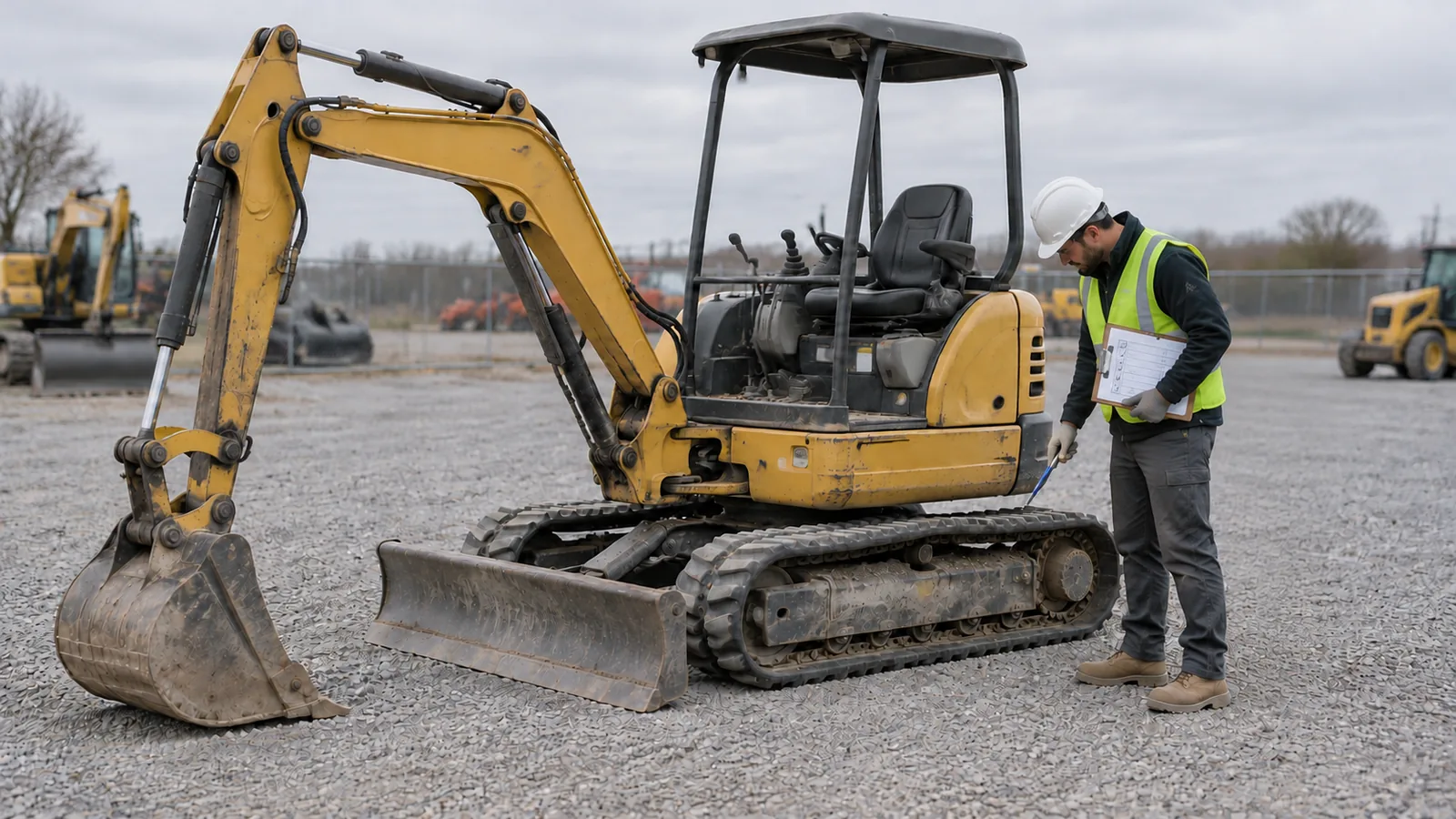
Before paying for a used mini excavator, confirm that it suits your work and that its identity matches the paperwork. Then check its condition in order: undercarriage, digging equipment and pivots, swing, travel and hydraulics, and the attachments you need. Watch a cold-start demonstration and agree the sale terms in writing. Buy when the evidence answers your main questions and the total cost, including identified repairs and delivery, still makes sense.
The steps below follow the buying sequence. They do not replace a qualified technician's inspection, but they show what to ask for and what that inspection should cover.
1. Confirm the machine suits the job
Start with your work, not the listing. Record the narrowest access point, overhead clearance, the depth you need at the distance where the bucket will work, where spoil will go, your attachments, and the weight you can transport and unload.
Compare those limits with the specifications for the exact model and configuration. Cab, arm length, blade, counterweight and tracks can change dimensions, working range and configured weight.
Our mini excavator sizing guide explains how to compare weight classes, travel width, digging envelopes and transport loads. If your jobs regularly combine digging with front-bucket loading, read our mini excavator vs. backhoe comparison first. A sound machine is still the wrong purchase if it cannot enter the site, reach the depth or run your attachment.
2. Request the evidence before you travel or pay
Ask every seller for the same information. It makes candidates easier to compare and shows which questions remain open.
| Ask for | What it helps establish | If it is missing |
|---|---|---|
| Photo of the serial or product identification number (PIN) plate | Identity, correct manuals and parts | Do not proceed until identity is confirmed |
| Dated hour-meter photo | Displayed reading at a known point | Ask whether the meter or display was replaced |
| Dated service and repair invoices showing the serial number | Maintenance performed and major repairs | List the undocumented periods and widen the inspection |
| Close-ups of both tracks, sprockets, rollers and idlers | Undercarriage wear and near-term costs | Request them or arrange an independent inspection |
| Photos of boom, arm, bucket, blade, pins and coupler | Visible wear, repairs and damage | Ask for close-ups of each pivot and welded area |
| Uncut cold-start and operating video | Starting behavior and changes as the machine warms | Agree a demonstration sequence in writing |
| Written list of known faults and repairs | The seller's disclosures | Ask for it before negotiating |
| Inclusion list for buckets, attachments and manuals | What the price actually buys | Confirm it in the sale terms |
| Configured weight and dimensions | Delivery planning and site access | Request figures for the machine as it will ship |
Mark each item received, unclear or missing. Missing evidence adds uncertainty that should shape your inspection plan and your offer.
3. Match identity, hours and ownership
Compare the serial number on the machine with the sale document and invoices, and ask the seller to explain any mismatch. Confirm the seller's right to sell, and resolve finance or ownership questions through the checks available where the machine is sold.
Ask whether the hour meter is original, was replaced, or ever stopped working. If an invoice dated 14 months ago records 2,140 hours and the meter now shows 2,610, the meter shows 470 hours of use since. Ask what work the machine did in that time.
Ask the seller to put known faults, repairs, accident damage and unresolved warnings in writing. A written disclosure gives you something specific to check and price.
4. Read the history and its gaps
Ask what the excavator did, where it worked and how it was stored. Caterpillar's undercarriage guide says application, underfoot conditions, operating technique and maintenance practices all affect undercarriage wear, and identifies abrasive material and demolition among the harder conditions. Caterpillar's rubber track undercarriage management guide. A machine that worked on rock or debris deserves a closer look than one used mainly in soft ground, even at similar hours.
Compare the records with the service schedule in the operation and maintenance manual for the exact model and serial range. Separate work that was done from work the seller plans to do, and ask for invoices for major repairs that identify the machine.
Gaps in the records do not prove neglect, but the inspection must then answer more questions, for example through fluid analysis, a longer operating test or a technician's assessment of expensive components.
5. Inspect the undercarriage as a complete system
Start with the machine on firm, level ground, the bucket and blade lowered, the engine stopped and the controls locked as the manual requires.
On rubber tracks, note cuts, cracks, missing lugs, tread depth and exposed steel. Caterpillar's guide says scuffs, cuts and missing rubber chunks can be normal, but recommends prompt repair when the embedded steel cords are exposed. It also says a serviceable track must hold proper tension, and its embedded steel parts should not keep skipping over the sprocket teeth when properly tensioned. Caterpillar's rubber track undercarriage management guide.
Wear limits are model-specific. For Caterpillar's own 301.5 to 308 mini excavators, that guide recommends replacing a track when tread depth falls below 5 mm (about 0.2 in). Use the figure published for the machine you are buying.
Then examine the sprockets, rollers and idlers. Note hooked or uneven sprocket teeth, rollers that are flat-spotted, sharp-edged or leaking, damaged idlers, and loose or missing bolts. Caterpillar's daily inspection guidance includes checking tracks for looseness, cracks and gouges, the undercarriage for debris and wear, and the final drives for leaks. Caterpillar's mini excavator inspection guidance.
Ask when track tension was last set using the manual's procedure. Caterpillar notes that tracks wear faster when too tight or too loose. Caterpillar's rubber track wear guide.
Replacement tracks alone are incomplete evidence. New tracks can make a machine look better while the sprockets, rollers and idlers still carry the old wear. Caterpillar's guide recommends evaluating the sprocket when a track is replaced, because a worn sprocket may need replacing to help extend the life of the new track. Ask when the tracks were fitted, what else was replaced, and for the invoice.
Caterpillar's excavator maintenance checklist says undercarriage problems can account for more than half of maintenance costs. Caterpillar's six-step excavator maintenance checklist. Get written quotes for identified components and list separately anything that still needs measurement.
6. Check the boom, arm, bucket, blade and coupler
Walk from the boom foot to the bucket, including the swing bracket, cylinder mounts and blade arms. Look for cracks, bends, repair welds, fresh paint over repairs, missing grease fittings and pins moving out of position. Caterpillar's checklist recommends inspecting buckets for cracks, bowing, pin and bushing wear, and abnormal wear on teeth, adapters, cutting edges and side cutters. Caterpillar's six-step excavator maintenance checklist.
Separate what you can see from what needs measurement or diagnosis. Scratched paint, a worn cutting edge or dented panels are cosmetic or routine wear. Play at a pivot, a crack near a weld, a bent cylinder rod or a structural repair needs a technician's assessment against the manufacturer's guidance before you can price it.
If the machine has a quick coupler, ask what type it is, whether its locking device and safety pin are present, and whether your attachments fit. The UK Health and Safety Executive (HSE) explains that a semi-automatic coupler needs a pin to secure the connection, and that the attachment can work loose and fall if it is missing. HSE guidance on quick hitches. Treat a missing or damaged locking part as a safety repair before use.
7. Observe swing, travel and hydraulics, cold and warm
With a qualified operator at the controls, swing both ways. Note knocking, hesitation, uneven speed or drift, and have a technician investigate rather than guessing at a cause.
Travel straight forward and backward on level ground, then turn both ways, noting pulling, hesitation or noise from one track. Run the boom, arm, bucket, blade and boom swing through their range, and look for jerky movement, settling of a raised boom or blade, and leaks. Caterpillar's daily inspection guidance includes checking cylinders, rods, hoses and seals for leaks, wear and damage. Caterpillar's mini excavator inspection guidance.
Check the cooling package for debris and leaks, photograph any active warning, and ask whether it has been diagnosed.
Watch how behavior changes as the machine warms. Kubota tells owners to let equipment warm up properly and to check the owner's manual for the appropriate warm-up time. Kubota's winter maintenance guide. A symptom that appears or worsens only when warm needs diagnosis before you price it.
8. Use the cold-start demonstration for what it can prove
Ask the seller not to run the machine beforehand. Agree the sequence: identification, meter, cold start, warm-up, travel, swing, each digging function, blade, auxiliary circuit and shutdown.
Keep everyone clear while it operates. HSE says most fatal and serious excavator injuries happen when the machine moves, slews and traps someone, or when the bucket or attachment strikes a person or falls, and it calls for keeping people away from the operating area. HSE excavator safety overview. Leave hands-on diagnostics, pressure testing, work under raised equipment and component measurements to a qualified technician using the applicable manual.
A demonstration can show starting behavior, warnings, smoke, noises and whether each function works under light load. It cannot measure pin and bushing wear, undercarriage life, hydraulic pressures or internal engine condition. Ask the inspector for written findings that separate observations from measurements and state what could not be checked.
9. Confirm attachments, auxiliary hydraulics and lifting
For each attachment you need, confirm the mounting or coupler, weight, required auxiliary flow and pressure, hydraulic lines, couplings and controls, including whether the circuit is one-way or two-way. Have it demonstrated or get written compatibility confirmation.
Confirm what the price includes: buckets by width, thumb, coupler, hoses, manuals and spare parts. A second bucket in a listing photo does not prove it is included.
If you plan to lift, ask for the lift chart for the exact machine and configuration. Caterpillar explains that lift capacity depends on the lift point height and radius and on the machine's configuration. Caterpillar's excavator lift-capacity guidance. Ask whether the machine has the equipment the manufacturer requires for lifting, and have a qualified person plan any lift.
10. Check parts and service support near your destination
Ask a service shop near the destination whether it can supply filters, tracks, rollers, bucket teeth, hoses and electrical parts for the model and serial range, and read its fault codes. Cheap machines become costly when routine parts come from far away.
11. Assemble the remote-inspection evidence
When you cannot see the machine in person, collect dated, continuous evidence:
- Photos of the identification plate, meter, both sides of the undercarriage, every pivot and the coupler, with the date stated.
- One uncut walkaround video from the identification plate to the meter.
- An uncut cold-start and operating video following the agreed sequence.
- Close-ups of every fault named in the seller's disclosure.
Where the price or open questions justify it, arrange an independent inspection. Our guide to buying equipment online safely covers seller verification, written terms and payment checks.
12. Compare the total cost of two candidates
The figures below are a hypothetical example in US dollars (USD) for two illustrative machines, not Affordable Tractors & Equipment (ATE) prices or real listings. Replace them with written quotes.
| Cost item | Machine A | Machine B |
|---|---|---|
| Asking price | $28,500 | $26,000 |
| Rubber tracks, pair, installed | $0 (fitted recently) | $2,600 |
| Drive sprockets, pair, installed | $1,100 | $0 (reported serviceable) |
| Bucket pins and bushings | $800 | $0 |
| Service due before work | $650 | $650 |
| Delivery quote | $1,900 | $1,900 |
| Total identified cost | $32,950 | $31,150 |
| Not yet priced | One undocumented service period | Swing hesitation when warm; rollers and idlers not yet assessed |
Machine B is $1,800 cheaper on identified costs, but it has an undiagnosed symptom and unassessed undercarriage parts. Until a technician diagnoses the swing hesitation, the comparison is incomplete.
13. Prepare delivery and send ATE the details
ATE offers Worldwide Doorstep Delivery: we arrange delivery directly to your address, and a quote request gives you the delivery details and pricing. Send the stock number or listing link, the attachments that must travel with the machine, the full destination address, and any access limits such as gate width, overhead clearance, ground conditions or unloading space. Our delivery quote checklist lists the site details to gather.
14. Put the sale terms in writing
Before payment, confirm in writing the serial number, agreed price, every included attachment and accessory, any repairs the seller will complete and how they will be documented, and the condition in which the machine will be delivered. List open questions and how each will be resolved. Keep the inspection report, disclosures, photos and videos with the sale documents.
Decision checklist: proceed, negotiate or pause
Proceed when:
- The machine fits the site, depth, reach, attachments and transport limits.
- The identity matches the paperwork and the seller's right to sell is confirmed.
- No unexplained safety or operating issue remains.
- The total identified cost fits your budget.
Negotiate when:
- Documented findings, such as worn tracks, sprockets, bucket pins or due service, have written quotes.
- Included equipment differs from what the listing suggested.
Pause when:
- Identity or ownership is unclear.
- A symptom such as swing hesitation, travel pulling or a warning has no diagnosis.
- A coupler locking part is missing or a structural repair has not been assessed.
- Key evidence is missing and the seller will not provide it.
Frequently asked questions
How many hours is too many on a used mini excavator?
There is no universal cutoff. Compare the reading with dated records, previous applications and the inspected condition. Higher hours with good records and a sound undercarriage can be a better buy than lower hours with no history.
Do new tracks mean the undercarriage is in good condition?
Not necessarily. They show one component was replaced. Ask what happened to the sprockets, rollers and idlers, and have them inspected.
Can I evaluate a used mini excavator from photos and video?
They answer many questions but cannot measure wear or diagnose a symptom. Add an independent inspection for a significant purchase or an unexplained finding.
What should a cold-start video show?
The identification plate and meter, a cold start, any warnings, travel, swing, every digging function, the blade and the auxiliary circuit, filmed continuously and dated.
What should I send ATE when I ask about a machine?
The stock number or listing link, your intended work, the attachments you need and your delivery destination with any access limits.
Ready to compare machines?
Browse mini excavators for sale and shortlist the ones that fit your job. Then request a quote with the machine identifier, the work you plan to do, the attachments you need and your destination, and we will reply with the details for that machine and its delivery.