
Equipment buying guides
Mini Excavator vs. Backhoe — Which Machine Fits Your Work?
Affordable Tractors & Equipment
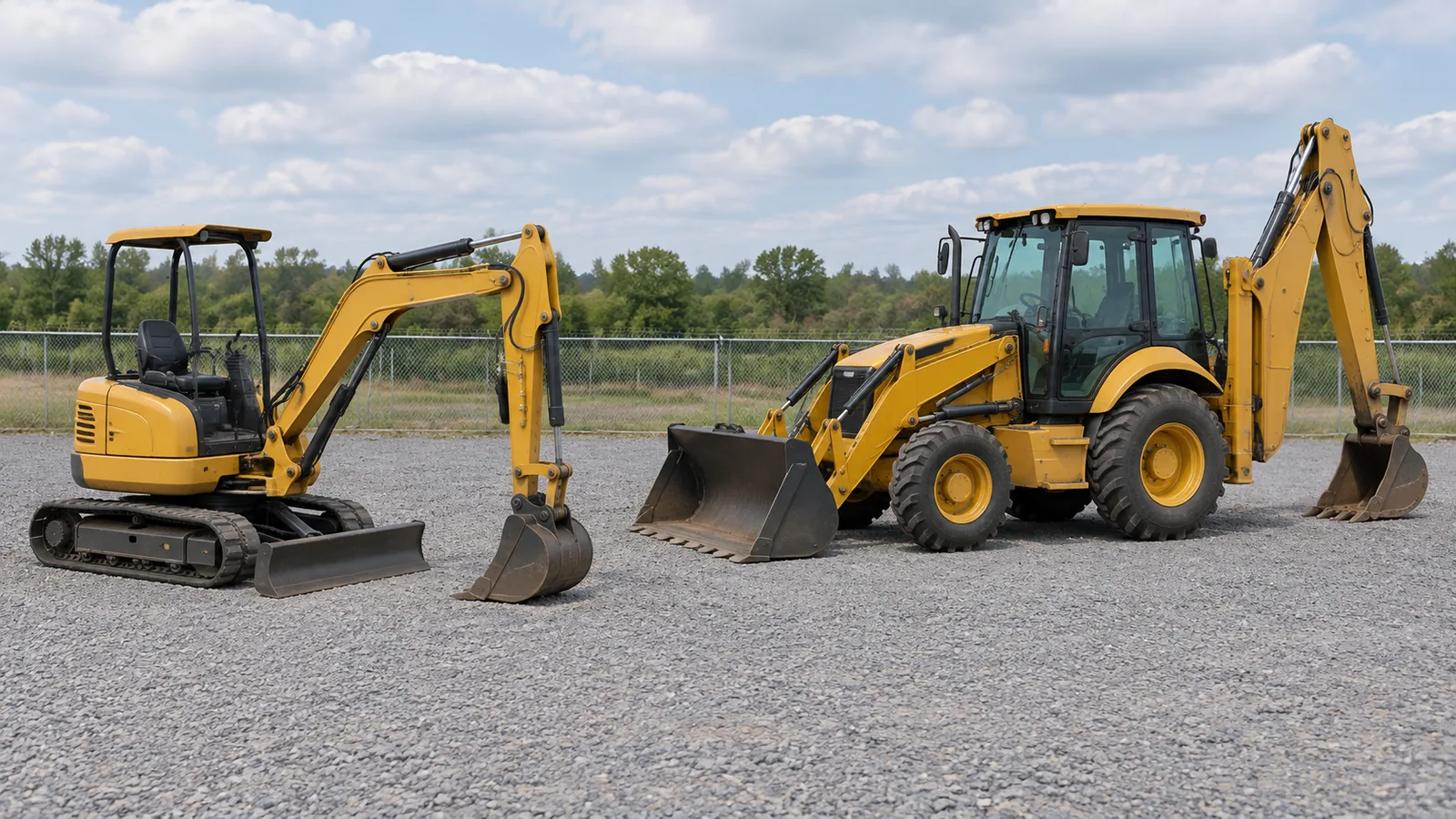
Start with a mini excavator when your recurring work centers on digging in restricted spaces and placing spoil around the machine. Start with a backhoe loader when the same jobs regularly require both rear digging and front-bucket loading or material movement. Then compare actual models for access, working range, attachments, transport, and condition.
The decision depends on the whole job. A machine may reach the trench bottom and still leave you with an awkward way to remove spoil. Another may handle both digging and loading but need more room than the site provides. Map the work sequence before comparing asking prices.
What are you comparing?
A mini excavator is a compact digging machine, commonly tracked, with an upper structure that can rotate around the undercarriage. A backhoe loader combines a front loader and a rear digging arm on a wheeled machine. Its rear digging assembly works within its specified swing range.
A tractor fitted with a backhoe attachment is another configuration buyers encounter. Identify that arrangement separately when reviewing listings and confirm its tractor, mounting system, and attachment specifications.
Caterpillar’s comparison material describes the excavator’s rotating working arrangement and the backhoe loader’s combined digging and loading functions. The practical buying question is how those functions fit your job. Caterpillar’s backhoe and excavator comparison.
| Factor | Mini excavator | Backhoe loader |
|---|---|---|
| Main work pattern | Digging, trenching, and placing material around the machine | Rear digging plus front-bucket loading and material movement |
| Access check | Travel width, height, turns, and working swing envelope | Overall dimensions, turning room, and deployed stabilizer footprint |
| Spoil handling | Bucket placement within working range, with separate transport where needed | Rear bucket for digging and front bucket for appropriate loading tasks |
| Capacity evidence | Applicable digging specifications and lift chart | Rear digging specifications plus separate front-loader ratings |
| Used-machine focus | Undercarriage, pivots, swing system, and hydraulics | Tires, axles, drivetrain, stabilizers, both workgroups, and hydraulics |
| Transport planning | Configured weight, dimensions, and attachments | Configured weight, dimensions, and attachments |
Measure access and working space separately
Measure the route from the unloading point to the work area. Include gateposts, tight corners, overhead clearance, and the surface the machine must cross.
Then sketch where it will stand, where it will swing, and where material will go. For a mini excavator, check the tail-swing radius and the movement of the boom, bucket, and any load. A compact-radius or zero-tail-swing design still needs room for the front working equipment.
For a backhoe loader, account for the setup required by the operator’s manual, including stabilizers and front-bucket positioning. Compare its deployed footprint with the available area.
Suppose a site has a clear entrance 1.5 m wide, about 4 ft 11 in. One candidate’s configured travel width is 1.4 m. That leaves 100 mm, about 4 inches, of total clearance on paper. Check the actual approach, protruding equipment, and ground conditions before deciding it can enter. Once inside, the machine still needs an appropriate working position.
The mini excavator sizing guide explains how to compare weight classes, dimensions, and digging envelopes. Use exact model measurements for either machine type. Caterpillar’s sizing guidance also emphasizes choosing an excavator around the work and site. Caterpillar’s excavator sizing guidance.
Check depth at the reach you need
Ask for the working-range diagram for the exact boom, arm, and bucket configuration. Locate the required digging depth at the horizontal distance where the bucket will work.
For example, a hypothetical trench is 2.4 m deep, about 7.9 ft, and a candidate has a published maximum depth of 2.8 m, about 9.2 ft. The apparent 0.4 m margin is useful only if the machine can achieve the required depth from its permitted working position. Account for the excavation plan, ground support, and space for spoil.
On a backhoe with an extendable dipper, identify whether a quoted figure applies with the extension retracted or extended. Check the applicable lift and working-range information too. John Deere’s backhoe documentation provides configuration-specific diagrams and lifting information that illustrate why the setup matters. John Deere 310L backhoe documentation.
Describe the material as well as the dimensions. Loose soil, compacted ground, buried roots, and rock can change the attachment and work plan. Share known conditions with the supplier when assessing candidates.
Before excavation, use the local process for locating buried services and establish the required excavation protection and edge setbacks.
Plan where the spoil goes
Start with the intended destination of the excavated material. It may stay beside the trench, go into a nearby container, or leave the site.
For a rectangular trench 30 m long, 0.4 m wide, and 1.2 m deep, the geometric volume is:
30 × 0.4 × 1.2 = 14.4 m³.
That is the volume in the ground for those assumed dimensions. The excavation shape, overdig, and the space occupied by loose material can change the handling requirement.
A mini excavator can place material within its working range, but a long route to a stockpile adds another task. A backhoe loader’s front bucket may serve that task when its capacity, ground conditions, and site layout suit the work. Include the time needed to change working position and move material in your comparison.
If you already have a loader and operator available, a mini excavator may complement that equipment. Our skid steer vs. compact track loader comparison helps assess the loader choice for the surface.
Match the machine to a recurring work pattern
Restricted-access drainage. Compare compact excavators first when the route and setup space constrain the job. Confirm depth at the required reach and a workable spoil route. If the front-loader function of a backhoe cannot be used in that space, its value on other jobs becomes part of the buying decision.
Open-site farm or property maintenance. A backhoe loader deserves consideration when you routinely dig, load loose material, and backfill on the same site. Record the volume and distances involved. Verify that the front loader and rear digging equipment both meet the tasks.
Repeated trenching with a separate loader. Consider how an excavator can work alongside the equipment already available. Check whether digging or spoil removal controls the pace. A faster digging cycle offers limited benefit if the hauling operation is already fully occupied.
Occasional digging around an existing tractor. Include the full cost and compatibility of any proposed tractor-mounted backhoe arrangement. Compare ownership with hiring or renting for the work you actually expect. Confirm mounting, hydraulic requirements, and approved tractor configurations.
Use several recent or planned jobs to make this assessment. A machine that fits one unusual project may be less useful across a year of recurring work.
Compare lifting and attachment requirements
Write down the heaviest load, lift radius, placement height, and attachment needed. Ask for the applicable manufacturer’s chart for that exact machine and setup.
An excavator’s lifting capacity changes with reach, height, orientation, and configuration. Blade position can matter. Caterpillar’s lift-capacity guidance describes reading the chart for the actual lift point height and radius. Caterpillar’s excavator lift-capacity guidance.
For a backhoe loader, check front-loader capacity and rear lifting capability separately. State which end will do the task and what attachment is fitted.
For breakers, augers, thumbs, or tilting equipment, verify the mounting system, attachment mass, required hydraulic flow and pressure, couplers, and controls. Identify what is installed on the unit offered for sale and what would have to be added.
Include the weight of the coupler, attachment, and any lifting equipment as required by the applicable chart and manual. Ask a qualified operator or supplier to confirm the proposed configuration.
Work out transport and support before buying
Use configured weight and dimensions to obtain a transport quote for each candidate. List buckets, attachments, and loose items separately so the carrier can establish the full shipment.
For delivery, send the address, entrance, site restrictions, and unloading arrangements. The delivery quote checklist organizes those details.
Also ask about support near the machine’s destination. Find out who can service the specific model, which wear parts are readily available, and what an identified repair would require. Obtain an assessment of unresolved faults before relying on an allowance in your budget.
Compare cost across a realistic year of work
Build the comparison around the same completed jobs. Include purchase and expected resale, scheduled service, wear parts, repairs, delivery, and any additional equipment or labor required.
The following hypothetical USD example compares annual costs for a buyer whose digging jobs sometimes require separate material handling. These figures are planning assumptions.
| Annual allowance | Mini-excavator option | Backhoe-loader option |
|---|---|---|
| Ownership cost after assumed resale, spread over the period | $4,000 | $4,500 |
| Service, wear, and repair allowance | $1,800 | $2,400 |
| Additional loader or handling service | $2,000 | $0 |
| Identified annual total | $7,800 | $6,900 |
Under these assumptions, the backhoe-loader option is USD 900 lower. The zero additional-handling allowance assumes its own loader can complete the required work.
If the buyer already has suitable loading equipment with available capacity, the added handling cost could change. For example, reducing that line to USD 500 makes the mini-excavator total USD 6,300. Account for the existing loader’s incremental fuel, wear, and labor when estimating that figure.
Add route-specific transport, fuel, financing, and operator costs where they affect the comparison. Record how many jobs each machine can actually complete within the required time.
Inspect the used machine that you will receive
Ask for the serial number, meter photo, dated service records, fitted equipment list, and known faults. Request a cold-start and operating demonstration by a qualified operator in a suitable area.
For a mini excavator, have the tracks, sprockets, rollers, idlers, pivots, coupler, swing system, and hydraulics assessed. For a backhoe loader, include tires, steering, axles, transmission, stabilizers, loader pivots, rear digging assembly, and any extendable dipper.
For either type, ask the inspector to explain leaks, play, warnings, and behavior that changes as the machine warms. Request written findings and repair estimates. Confirm the included buckets and attachments in the sale documents. If you choose a mini excavator, our used mini excavator buying checklist walks through these checks step by step.
When comparing mini excavators for sale and backhoe loaders for sale, shortlist the units that fit your measured site and recurring jobs. Then compare condition and the cost to put each machine to work.
Frequently asked questions
Is a mini excavator better for trenching?
It is a strong candidate when the working space, swing arrangement, and spoil-placement needs suit it. Compare the exact digging envelope, bucket, ground conditions, and handling plan with the backhoe candidate.
Can a backhoe loader replace a mini excavator and a separate loader?
It may cover both functions on suitable jobs. Check access, digging performance, loader capacity, travel distance, and the time needed for the work sequence. Compare those tasks with the output you need.
Does an excavator’s blade do the same work as a loader bucket?
Check the blade’s manufacturer-approved functions. If the job includes collecting and carrying loose material, evaluate the equipment for that handling task and include it in the work plan.
Which costs less to maintain?
Obtain estimates for the actual models and condition. Mini-excavator undercarriage costs and backhoe-loader tire and drivetrain costs can affect the comparison. Include both scheduled work and repairs already identified.
What should I send to get help comparing machines?
Send the job type, access measurements, required depth and reach, spoil destination, attachments, and delivery address. You can request an equipment quote with the listing links and ask for the applicable specifications and configuration details.