
Tractor Buying Guides
Kubota vs. Mahindra Tractors: Which Should You Buy?
Affordable Tractors & Equipment
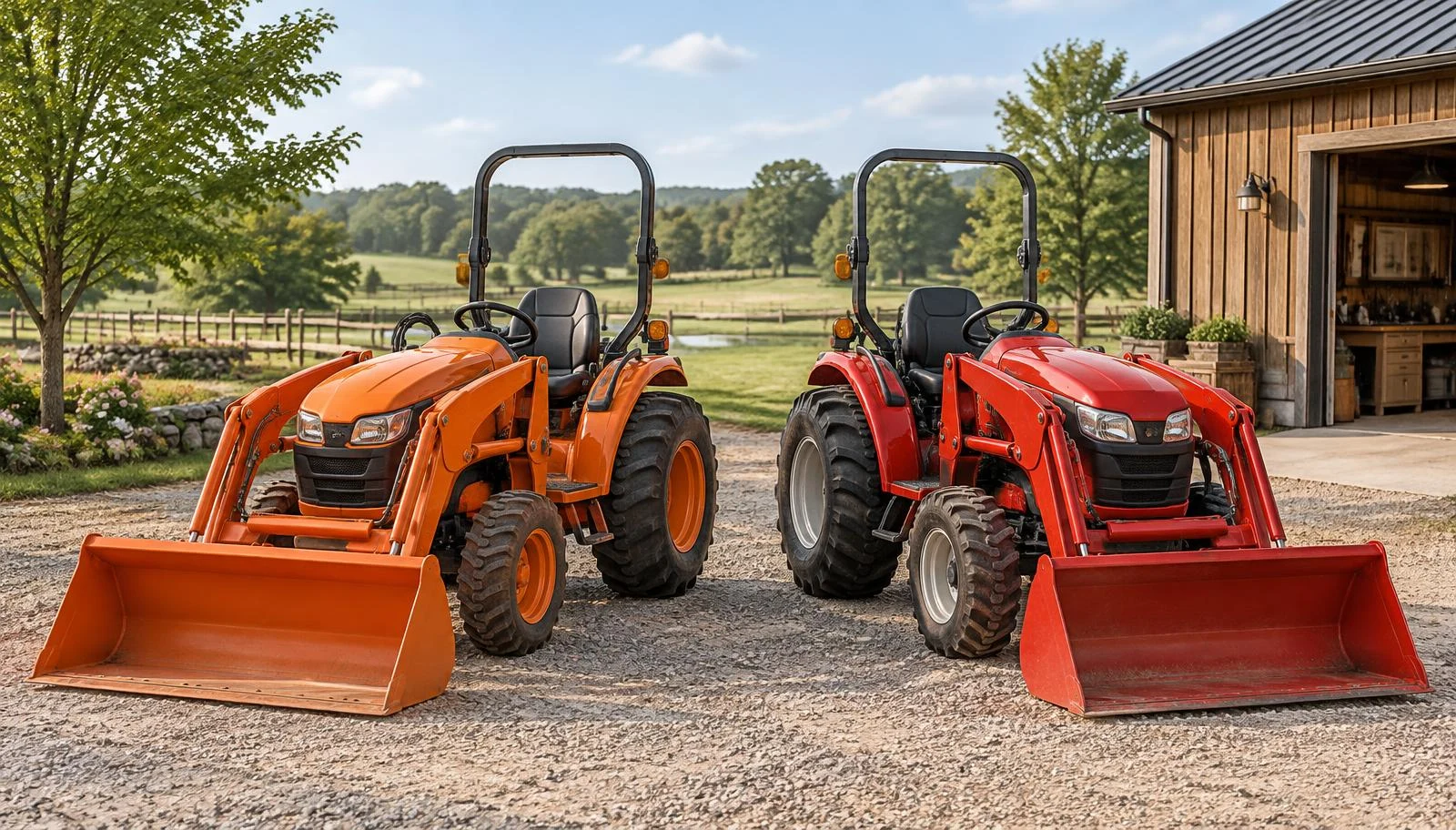
The better purchase is the tractor that meets your work requirements, has acceptable condition and history, and can be supported where you will use it. That could be a Kubota or a Mahindra. The brand name does not settle the equipment comparison.
Start with similarly sized, similarly equipped candidates. Then compare the exact transmission, implement requirements, loader package, maintenance evidence and complete purchase cost.
This guide uses the Kubota L3902 HST and Mahindra 2638 HST as a documented compact-tractor example. It does not rank every model from either manufacturer or claim that the two machines have been independently tested.
Start with the same class and configuration
A small subcompact tractor and a larger compact tractor may both wear familiar badges, but their differences do not establish which manufacturer makes the better tractor.
Build a fair comparison first:
| Match these items | Why it matters |
|---|---|
| Intended jobs | Both candidates must address the same work |
| Approximate machine class | Avoid comparing fundamentally different equipment sizes |
| Transmission | Identify HST, gear or shuttle versions |
| Operator configuration | Separate open-station and cab versions |
| Loader and attachments | Compare the package being offered, not an assumed accessory |
| Condition | Keep new/used status, faults and history visible |
| Market and model applicability | Specifications and support may depend on the version |
If you are still choosing the machine class, read our compact vs. subcompact tractor guide.
Once the class is appropriate, compare the machines themselves.
A documented example: L3902 HST vs. 2638 HST
The manufacturer documents below describe compact tractors with similar published engine-power figures and three-range hydrostatic transmissions.
| Published specification | Kubota L3902 HST | Mahindra 2638 HST, open station |
|---|---|---|
| Engine-power figure | 37.5 hp, gross | 37.4 hp, published engine rating |
| PTO power | 30.3 hp | 31 hp |
| Engine cylinders | 3 | 4 |
| Transmission | Three-range HST | Three-range HST |
Sources: Kubota L02 brochure and Mahindra 2600 Series brochure.
These figures belong to the configurations covered by those documents. They are not confirmation of a particular machine’s specifications, fitted equipment or present availability.
The documents do not establish identical power-testing conditions. Small differences between the published figures should not be treated as proof of a noticeable advantage in your work.
Likewise, cylinder count is a specification—not a reliability score, fuel-consumption test or prediction of service life.
What the power figures help you decide
PTO power matters when an implement specifies a requirement at the power take-off. Engine horsepower and PTO horsepower answer different questions.
For a powered rear implement, start with its exact model and documented requirements. Establish the required PTO speed, power, mounting and other compatibility conditions before deciding whether either tractor belongs on the shortlist.
A published PTO figure is only one part of that decision. It does not prove that every implement within an advertised horsepower range will fit, lift correctly or work appropriately in your conditions.
The Kubota brochure also separates gear-drive and HST versions of the L3902. That distinction is a useful reminder: selecting a different transmission can change the specification you should use. Kubota’s transmission and PTO specifications
Compare the version you are actually considering, not a convenient number from another column.
Loader work: compare the complete package
Do not declare a loader winner from an engine-power table.
First identify the tractor, fitted loader, bucket or forks, intended load and required placement height. Then compare the applicable ratings and restrictions.
Record the measurement basis beside every capacity figure:
- Is it rear hitch lift or front-loader lift?
- Where is the load measured?
- At what height?
- Which attachment or loader configuration applies?
- What ballast and operating conditions does the documentation require?
Mahindra’s 2600 brochure distinguishes loader models and identifies full-height pivot-pin capacity separately from breakout force. Those labels matter when comparing an offer. Mahindra loader documentation
Do not compare breakout force with another machine’s lifting rating. Do not assume the loader shown in a general brochure is fitted to the used tractor being offered.
An included loader is valuable only if its condition and documented capability fit your work.
Hydraulic specifications need matching definitions
A total hydraulic-flow figure and an implement-pump figure are not automatically interchangeable.
Manufacturer tables can separate steering and working circuits. Compare the appropriate supply, pressure, outlets and controls for the attachment you intend to use.
Ask for the equipment configuration to be identified clearly. A tractor may be offered without a valve or connection that appears as an option elsewhere in the range.
For each hydraulic attachment, make a simple record:
| Requirement | Attachment needs | Candidate provides |
|---|---|---|
| Mounting and connection | Identify specification | Confirm exact equipment |
| Hydraulic supply | Record documented requirement | Identify applicable circuit |
| Controls and outlets | List required functions | Confirm installed equipment |
| Operating restrictions | Record manual requirements | Resolve compatibility |
Leave unanswered cells unresolved. A larger headline number should not conceal a missing connection or control.
Compare dimensions, weight and access
Photographs can make two tractors look similarly sized even when their configurations differ.
Measure gates, storage openings and restricted routes. Request dimensions for the actual tires, operator configuration, loader and attachments.
Separate these measurements from generic series specifications. Minimum tread width is not necessarily the width of the tractor as offered, and a base weight is not necessarily a complete working or transport weight.
Weight alone does not prove traction, turf suitability or safety. The useful question is whether the actual package suits the property and intended operation.
For international buyers, establish the machine’s relevant measurements and configuration before requesting destination-specific transport details. Do not build a delivery comparison from guessed dimensions.
Transmission labels do not describe the entire experience
Both example configurations use three-range HST, but that does not make every control, adjustment or operator-station feature identical.
Identify what the person using the machine needs:
- Frequent direction changes or steady travel.
- Access to loader controls.
- Reach to pedals, levers and switches.
- Entry and exit arrangements.
- Visibility with the proposed attachment.
- Comfort during the expected working period.
Where possible, assess the actual configuration rather than relying on an appearance comparison.
For remote buying, request clear operator-station views and explanations of installed equipment. Do not treat a video as equivalent to personally assessing comfort or receiving operator training.
A feature matters when it solves a real requirement—not simply because it appears in one brochure.
Which brand is more reliable?
The specification documents used here do not provide comparable failure-rate data. They cannot support a universal statement that one brand lasts longer or needs fewer repairs.
For a used purchase, evaluate the machine’s own evidence:
- Identification and configuration.
- Available service history.
- Known faults and previous repairs.
- Assessment findings and their limitations.
- Work required before your intended use.
A brochure cannot establish how a particular tractor was operated or maintained. A strong brand reputation cannot repair a gap in the machine’s records.
Wisconsin Extension recommends considering local service and parts support, discussing maintenance requirements and obtaining help with a pre-purchase assessment. Used tractor maintenance planning
For uncertainty about displayed readings and documented history, use our used tractor hours guide.
Check parts and service where the tractor will operate
For worldwide buyers, “dealer support” needs a location and a specific machine behind it.
Before choosing either offer, identify a qualified service provider at or near the operating destination. Give them the exact model and relevant identification, then establish what support they can actually provide.
Useful questions include:
- Can they work on this particular model and configuration?
- Can they identify and obtain the required parts?
- What information do they need to confirm applicability?
- Are there known limits to their support for that market version?
- How would an interruption to your work be handled?
Do not assume that a familiar badge guarantees immediate local parts availability or that a service arrangement in one country applies everywhere.
Keep any written warranty or repair coverage attached to the actual transaction. Manufacturer promotions and brochure programs should not be assumed to be benefits offered with an independent equipment sale.
Is Mahindra cheaper than Kubota?
That cannot be answered responsibly for every model, country and equipment package.
Compare current written offers with the same scope. A tractor-only price is not equivalent to a package including a loader, attachments, documented repairs or destination-specific delivery.
Consider two hypothetical offers. These numbers illustrate arithmetic only; they are not market averages, ATE prices or typical repair estimates.
| Illustrative item, USD | Offer A | Offer B |
|---|---|---|
| Equipment price | $19,000 | $21,000 |
| Identified pre-use work | $1,600 | $500 |
| Separately needed hardware | $400 | $700 |
| Subtotal of listed items | $21,000 | $22,200 |
The initial price difference is $2,000. After the listed items, it is $1,200.
Neither subtotal includes every possible purchase or ownership expense. Add actual delivery quotations and other applicable items before making a decision. Keep unknown costs visibly unknown.
The cheaper badge is not the question here. The comparison is what each complete offer provides and what you must still arrange.
Three situations that can change your choice
These are hypothetical buying situations, not customer stories.
Similar capability, different local support
Two candidates meet the job requirements, but only one has clearly established service support near the destination.
That support can be a practical advantage. Confirm what it covers and the costs involved rather than assuming either brand always has the stronger network.
Similar asking price, different included equipment
One offer includes the mounting parts and attachment you need. The other requires separate purchases.
Identify those items and confirm compatibility. A complete package may offer better value even if its initial tractor price is higher.
Similar specification, different documented condition
One used machine has a clear service timeline and explained repairs. The other has unresolved history.
The documented machine offers more information for the decision. That is not a guarantee of reliability, and it does not make it preferable at any price, but it changes the uncertainty you are accepting.
Build a comparison that can eliminate unsuitable offers
Use the following worksheet before assigning importance to personal brand preference:
| Decision | Kubota candidate | Mahindra candidate |
|---|---|---|
| Exact model, year and transmission | ||
| Intended jobs supported | ||
| Implement and mounting compatibility | ||
| Appropriate PTO specification | ||
| Hydraulic requirements met | ||
| Loader configuration and applicable ratings | ||
| Actual access and storage dimensions | ||
| Condition and service evidence | ||
| Known pre-use work | ||
| Included and excluded equipment | ||
| Support at the operating destination | ||
| Complete written purchase details |
Mark each requirement confirmed, unresolved or unsuitable.
An essential incompatibility should not disappear inside an overall score. Eliminate an unsuitable candidate, resolve material unknowns, and then compare the remaining offers.
Our used tractor buying checklist provides a broader framework for records, included equipment and written terms.
When does one offer become the better choice?
A Kubota offer becomes stronger when its verified configuration, condition, included equipment and support better satisfy your requirements at an acceptable complete cost.
The same reasoning applies to a Mahindra offer.
That is a conditional purchase recommendation, not a declaration that all tractors from one manufacturer are superior.
Start by reviewing Kubota equipment and Mahindra equipment, then narrow the comparison to actual offers. Category listings are a starting point; confirm availability and specifications for each machine.
Frequently asked questions
Is Kubota better than Mahindra?
There is no universal answer across every model and buyer. Compare suitable configurations, documented condition, local support and complete cost. A brand-wide verdict hides differences that can change the purchase.
Which Mahindra compares with a Kubota L3902 HST?
The 2638 HST open-station configuration is a useful documented starting example because of its similar published engine-power figure and three-range HST. That does not establish equal capability in every task or confirm current stock.
Does more PTO horsepower mean a better tractor?
It may matter for a specific implement requirement, but it does not settle mounting, hydraulics, lifting, access or condition. Confirm the specification’s applicability before treating a small published difference as meaningful.
Which brand has better resale value?
This guide does not contain a comparable transaction dataset proving a worldwide resale advantage. A useful analysis would match models, age, condition, equipment, market and sale date. Asking prices alone do not establish completed-sale values.
Can I use attachments from one brand on the other?
Do not assume compatibility from the brand name or hitch category. Identify each attachment and verify its mounting, power, hydraulics, weight and other manufacturer requirements against the tractor configuration.
Is a new tractor always preferable to a used one?
New/used status and brand are separate comparisons. Evaluate the actual condition, included equipment, written terms, known work and total cost for the offers available to you.
Can international buyers rely on US brochure specifications?
Use the cited documents to understand the configurations they cover. Confirm the actual machine’s identification, market version and applicable documentation before purchasing or arranging support elsewhere.
Compare specific tractors with Affordable Tractors & Equipment
Send us the listing links or stock numbers, intended jobs, existing implements, destination and budget. Include any support or configuration questions that remain unresolved.
Request a tractor quote to compare actual equipment offers. Manufacturer names identify the machines; they do not imply an authorized dealership or partnership.